William Shakespeare
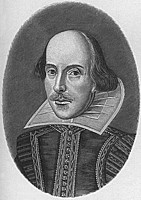 There
is some question as to who William Shakespeare really was. Some people are sure
he was the actual author of the many plays and sonnets that are attributed to
him. Some are just as certain that it was a ruse to hide the identity of someone
else. There are probably numerous candidates for the "real William Shakespeare"
though I doubt many of them know it or care about it any more.
There
is some question as to who William Shakespeare really was. Some people are sure
he was the actual author of the many plays and sonnets that are attributed to
him. Some are just as certain that it was a ruse to hide the identity of someone
else. There are probably numerous candidates for the "real William Shakespeare"
though I doubt many of them know it or care about it any more.
At any rate, what little does seem to be apparent is quickly told. Aside from his vital statistics, which can be found easily, it seems pretty well settled that when he married Ann Hathaway (Hathwey) she was already pregnant with their first child. One writer has said, "We have good reason to believe that the marriage was hastily arranged: there was only one reading of the banns (a church announcement preceding a wedding that allowed time for any legal impediments against it to be brought forward before the ceremony took place), an indication of unusual haste."
It also seems well established that he showed up in London sometime in the 1590s, without his wife and three children. It has been rumored that he left his home area to escape a poaching charge. As far as can be told from history, they apparently spent the better part of twenty years apart while he was working in the London theater. This does not indicate any great love between them and, when combined with the subject matter of some of his sonnets, also has left some cause for speculation about faithfulness, at least on his side.
Whatever his personal history may or may not have been, the plays and poems can be judged purely on their content and found to be wanting and unsuitable for Christians' entertainment purposes, though they may bear some historical value.
The plays exhibit murders, adultery, magic/occult practices, suicide, witchcraft, anti- Semitism, ghosts and many other such like. You can read summaries of the plays at: The Literature Network. Shakespeare's plays were really nothing more than high class soap operas of that day, a good deal better written than modern ones, but the same basic content nonetheless.
| Links are included to help clarify terms. This does not imply that all information offered at these links is accurate nor that we agree with it. |
Furthermore, The Wordsworth Dictionary of the Occult - An exploration of the esoteric and mysterious from darkest antiquity to the present, by Andre Nataf, claims that Shakespeare's writings are alchemical and relate to other esoteric things. (This is one of "their" books, not one exposing the occult.) Quoted from page 220:
"The royal road to hermetism
"Alchemy is at the heart of Shakespeare's works.
"Shakespeare stands on the threshold of the medieval and modern worlds. It is not surprising that...his work should be filled with mythology, magic and esoterism. Shakespeare was also undoubtedly affected by illuminism and Cabalism which were at that time enormously influential in intellectual circles.
"Esoteric exegesis
"A Midsummer Night's Dream is deeply marked with popular cosmology; Love's Labours Lost carries an Orphic love theme, with the lovers setting one another tests. The Merchant of Venice contains Pythagorean ideas...
"In The Tempest, we see a magician fighting against the forces of evil and putting young lovers through an initiation. However, alchemy has pride of place, especially in The Winter's Tail. The play is saturated with alchemical philosophy and symbolism, as Paul Arnold points out. For example, the striking scene of Hermione's 'resurrection' must surely be based on the alchemical description of the king and queen going down into the tomb and rising again..."
------------------------
I find it curious that so many Christians today think that Shakespeare is great literature. I cannot help but wonder what our brethren of that day had to say about him and what they thought of his mystical occult writings and plays. How different is it really from the modern day "Harry Potter" and Twilight stories? Certainly it is better written, but is it "classic" and "necessary" simply because it is highly acclaimed by the world? Should it be excused from it's wicked content simply because it is old and well written? Rubbish doesn't become better with age, you know.
It also makes me wonder that Shakespeare became so popular in the same general era in which translation of the Bible into English was a major issue, and the King James Version was ultimately done. Is it mere coincidence that this man wrote such powerful esoteric and occult material that it captured the mind of a nation and eventually the world at the same time that the Bible was being brought so powerfully into English? I am inclined to wonder if he was not a servant of our adversary the devil who was used to turn people's attention away from the words of God. It is certainly something to consider. We generally find that when God is moving to do some mighty work it will be mightily attacked or countered by Satan and his servants.
The Lord described the evil people in Romans 1 as 29 Being filled with all unrighteousness, fornication, wickedness, covetousness, maliciousness; full of envy, murder, debate, deceit, malignity; whisperers, 30 Backbiters, haters of God, despiteful, proud, boasters, inventors of evil things, disobedient to parents, 31 Without understanding, covenantbreakers, without natural affection, implacable, unmerciful: This pretty well describes the characters and plots of Shakespeare's plays. But the passage goes on to warn us, 32 Who knowing the judgment of God, that they which commit such things are worthy of death, not only do the same, but have pleasure in them that do them.
Philippians 4:8 Finally, brethren, whatsoever things are true, whatsoever things are honest, whatsoever things are just, whatsoever things are pure, whatsoever things are lovely, whatsoever things are of good report; if there be any virtue, and if there be any praise, think on these things.

Links
Disclaimer all Bible versions
other than the KJV,
and possibly some content:
For further information you may wish to do some research at A Guide to Shakespeare.
For further information relating to cabalism, esoticism and other things that Shakespeare was portraying - The Labyrinth Journey: Walking the Path to Fulfillment?
background & most graphics by mary vannattan
written circa 2010
updated 2015
CA