THE
HOLY CITY-- A Deadly Song The
life and personal life of hymn writers must be considered
before we sing hymns
they wrote.Hymn
Writer-- Mr. Michael Maybrick
"The
late Mr. Maybrick was a prominent Freemason, having been Grand Organist of Grand
Lodge in 1889." Read
the story of the man's life.
It is a very profane life indeed.
We have this week, with
the profoundest regret to record the death of Mr. Michael Maybrick, J.P., of Lynthorpe,
Ryde. The sad event took place at Buxton, whither the deceased gentleman went
to recruit his health about three weeks ago. He had shown signs of failing health
lately, but no one anticipated so sudden a termination to his useful and valued
life He
retired to rest on Monday night after having been chatting and joking with friends,
apparently in his usual health, but at 10 o'clock on Tuesday morning he was found
dead in bed, death having taken place in his sleep.Mrs.
Maybrick, who was in Ryde, left by the 2 o'clock boat, and the body was brought
to Ryde at 11 p.m. on Wednesday by special boat for internment this (Saturday)
afternoon. The first part of the Burial Service will be at All Saints' Church,
at 3 p.m. The Vicar (the Rev. Hugh Le Fleming) will officiate. The Mayor and Corporation,
the Freemasons, and other public bodies will attend. Mr Douglas B. Hall, M.P.,
has wired that absence on a lengthy yachting cruise will prevent his being present.
The funeral arrangements are in charge of Mr C. Langdon.
When the news flashed along the wires that Michael Maybrick, or 'Stephen Adams'
as he was better known to many, was no more, a painful sense of personal loss
was created such as the death of few men could arouse. Who in the British Isles
has not heard with irresistible appeal the attractive music of his many songs,
all pure and enabling, some grand and devotionally inspiring in the sublimity
of their religious feeling. This sense of loss was felt even by those who had
never come within the sphere of his magnetic and charming personality. How much
more poignant must be the grief of we in the Wight, who have been privileged for
the last two decades to know and regard with unstinted admiration his kind, chivalrous,
and noble self, as one writer truthfully hits off his magnificent characteristics
in telling and happy phrase. To the people of Ryde the loss will be irreparable,
and to very many of them life cannot be exactly the same again since so true a
friend, so strikingly endowed and so unique a man has gone where beyond these
voices there is peace.
Mr. Maybrick's appointment to the Mayoralty of Ryde in 1900 came as a great surprise
upon the majority of people in the borough, but it was a brilliant success from
every point of view, and that success was rounded off and made in every way complete
by the womanly tact, winning grace and charm of Mrs. Maybrick's ever watchful
and clever help. The lustre of this brilliancy was never dimmed, but rather increased.
Few who were present will ever forget the then Mayor of Ryde's reading of the
proclamation of King Edward VII., his addresses to the school children, or his
kindly interest in the poor of the town. Mr Maybrick had the distinction of being
Mayor of Ryde in the Coronation years of Edward VII, and of George V., and he
represented the town in Westminster Abbey at those Coronations. Ryde's musical
renown in these later years owes much to its five times Mayor for his promotion
and support, most ably and enthusiastically assisted by his friend Mr. John I.
Barton, of the winter and summer concerts given by the R.M.A. Band.
Mr. Maybrick was a patriot to the fingertips. As President of the I.W. Conservative
Association he worked most strenuously and never spared himself, and it is no
exaggeration to say that the splendid victory of Mr. Douglas B. Hall, M.P., as
Member for the Isle of Wight, was in no small degree due to his exertions. He
was a most effective speaker. His fine presence, resonant and musical voice used
with consummate skill, and his winning smile were great helps, but his strength
as an orator was as the strength of ten because it was that of a man sincere to
the core. He was no frothy emotionalist, no opportunist at the head of a party
machine; he was out to advocate principles, which he believed vital, and which
were ingrained in his very nature. His
excellence as a speaker was made all the greater by his possession of the saving
grace of humour. Few could make a more acceptable after-dinner speech than he.
All the sunshine of his nature, all his evident joy of life, all the affectionate
interest in his fellows which characterised Michael Maybrick were poured forth
in rich abundance, and he played on his audiences as he played the piano or organ,
with the hand of a master. Mr. Michael Maybrick achieved remarkable success in
many and diverse ways, but he was never spoiled thereby. To the very last he was
a perfect example of one of nature's gentlemen, a true friend, wise, generous,
and helpful to rich and poor alike, without distinction of rank, creed or politics.
He imparted some of the brightness of his own sunny nature to every one with whom
he had to do or into whose society he was introduced.
The late Mr. Maybrick was for many years a member of the directorate of the County
Press, took a lively interest in its welfare, and brought to bear on the promotion
of that welfare the great business aptitude with which he was endowed. This journal
and its staff have thus lost three invaluable directors and friends in the short
space of nine months.
The profound and respectful sympathy of the whole community is with Mrs. Maybrick
today. They try, though they must fail, to measure her loss by theirs; they try
because they sincerely wish to sympathise with her to a degree proportionate to
the loss which they themselves feel, and to the debt of gratitude they owe to
her for all she has done for him and them.
VOCALIST AND SONG-COMPOSER
The world has lost one of its most popular song composers by the death of 'Stephen
Adams'. The deceased gentleman was born at Liverpool in 1844. In his early childhood
he developed a passion for music. He could play the piano with brilliance and
accuracy when he was 8 years old. At 14 he was appointed organist at St. Peters,
Liverpool, and when he was only 15 he distinguished himself as a composer of anthems.
At 22 he went abroad to study harmony and composition at Leipzig, under Moscheles,
Plaidy, and Richter, and he did so with so much success as to receive an excellent
testimonial from Plaidy. In
Leipzig, however, it was discovered that he possessed a voice of superior quality,
and as a consequence he sacrificed his contrapuntal studies in order to devote
himself to vocal cultivation. For some time he studied at Milan under Nava, and
in 1870 he appeared at the new philharmonic concert with such decided success
that he joined the late Mme. Sainton-Dolby in her farewell tour. His rendering
of the part of Telramund in Wagner's 'Lohengrin', won for him a leading place
in English opera. In 1871 he joined Mr. Sims Reeves in an operatic tour, and his
popularity grew so rapidly that he soon found it profitable to exchange the operatic
stage for the concert room. He appeared in public with some of our best vocalists,
having become a most popular baritone singer. 'Stephen Adams' was still more successful
as a composer of songs. Thirty
years ago he was probably the most popular composer of the day. His first song
was 'A Warrior Bold', which remains one of the most popular of its class. He wrote
it while lying ill in bed, and accepted 5s for it plus a royalty. This royalty
amounted to well over a thousand pounds within a few years. 'A Warrior Bold',
however, was not an instant success. Mr Maybrick leaped into prominence in 1878
when he sang 'Nancy Lee', and within 18 months 70,000 copies of it had been sold.
He offered 'Nancy Lee' to Mr. Arthur Boosey for 20 guineas, but this was refused.
After
hearing him sing it at the St. James's Hall, however, Mr Boosey offered 100 guineas
for the song. This time Mr Maybrick refused, and the song that Messrs. Boosey
might have obtained for £21 ultimately cost them several thousands in royalties.
His next success was 'the Midshipmite', which he sang at the St. James's Hall
concerts. The words of this and many other favourites were by Mr. Frederick E.
Weatherly. Other songs which rapidly caught the popular fancy were 'The Tar's
Farewell', 'The Little Hero', 'The Valley by the Sea', 'Children of the City',
'They All Love Jack', 'The Blue Alsatian Mountains', 'Nirvana', 'Your Dear Brown
Eyes', 'Thora', 'Mona' and 'The Veteran's Song'. Two
of his sacred songs which have become world famous are 'The Star of Bethlehem'
and 'The Holy City'. The latter had the distinction of being translated into German.
In recent years Mr. Maybrick's compositions have included 'Babylon', 'Farewell
in the Desert' and 'Love Eternal'. Out of the profits of his ballads Mr. Maybrick
founded a Ballad Singing Prize at the Royal Academy of Music. In the songs of
'Stephen Adams' there is a simplicity that one rarely finds in the modern 'ballad'.
'The
Star of Bethlehem' may be said to represent the climax of his work, simple in
idea, and very direct - ingenuous, even - in utterance. This was an immensely
popular song, and, indeed, is still very popular in the more outlying parts of
these kingdoms. The public taste today seems to lie in the direction of something
more artificial, something less sincere. But it is unlikely that the composer's
name will be forgotten for many years; his sentiments were too human, his feelings
too sensitive.
In considering the world-wide delight which 'Stephen Adams' gave by his inspired
music, one cannot but be struck by the absence of any recognition of his work
on the part of the Government of the country, especially when one recalls the
recent rather lavish distribution of honours in many cases to merely local party
politicians, which are fresh in the minds of Islanders. Such recognition would
have gratified the lovers of our departed friend's rousing ballad music and done
honour to the land which gave him birth.
The Daily Chronicle says: 'He himself recognised that he belonged to that section
of composers who bid for popularity in their own life-time, and although his own
ballads were brilliant when gauged by the standard of Tosti and Piccolomini, he
was a great admirer of the newer 'Landon Ronald' style of song, which is fast
usurping their place in concerts. . . . He was at one time captain in the Artists'
Volunteer Corps. These activities were in keeping with his vigorous personality.
For he was a tall, well-proportioned man, brisk in his movements, pleasant and
sympathetic in conversation, and always cheerful in his views. But, of course,
he will be best remembered for the haunting cadences and the emotional fervour
of 'The Holy City' and 'The Star of Bethlehem'.'
Mr F. E. Weatherly, who composed the words of 'Nancy Lee', 'The Midshipmite',
'The Star of Bethlehem', 'The Holy City', and other songs for 'Stephen Adams'
to set to music was formerly a law coach at Oxford. He still writes songs and
has a large practice as a barrister on the Western Circuit.
It was at a small theatre in Milan that Mr. Maybrick made his first appearance
as a vocalist.
Mr. Maybrick's excellencies as a vocalist, in addition to his magnificent voice,
were his admirable enunciation and direct and incisive style.
Concerning the popularity of Mr. Maybrick's 'Nancy Lee', a story is told of a
musician who, proceeding to New York, was much annoyed by an invisible fellow
passenger who whistled 'Nancy Lee' incessantly. The next morning revealed the
fact that the whistler was 'Stephen Adams' himself. Mr. Maybrick continued to
produce songs for a period of over 37 years. Latterly a change of style was to
be noted, and what now proves to be his last published song, which was issued
this month by Messrs. Boosey and Co., is said to be entirely unlike anything else
he has written. It is entitled 'The Bells of Lee', and the words telling of parted
lovers are by Mr. F. E. Weatherly.
Mr. Weatherly reckoned on making �500 a year by his art of preparing the sentimental
or rollicking words for the musical framework of Stephen Adams's and other writers'
songs. It is doubtful whether any writer of songs has ever surpassed his financial
success.
STEPHEN
ADAMS ON HIS SONGS
Speaking at the Mayoral banquet at Ryde in 1911, when relinquishing the duties
of Mayor, Mr. Maybrick said the Mayor had referred to him as Stephen Adams, and
they saw how a man could play two parts - one day he was Michael Maybrick and
the next Stephen Adams. His great gratification was, and always would be, whilst
he had the breath of life, that he had given pleasure to thousands of people.
When he wrote his first song, 'A Warrior Bold', he was living in chambers. He
had a bad cold and was unable to sing at Wolverhampton, where he had an engagement.
While in bed he wrote the words and music of that song and took it to Mr. Arthur
Chappell, of Chappell and Co. When the latter wanted to know what it was like
he sang it to him. He said he would take five guineas for it, but Mr. Chappell
said 'What! For an unknown composer?' It
ended in his selling his first song for 5s. But there was a royalty attached,
and that had gone a long way beyond four figures. Some time after he wrote 'Nancy
Lee', he thought in 1878. That was also written when he was in bed, with a bad
cold. He took that to his dear old friend Mr. Arthur Boosey, who kept him on tenterhooks
for about six months. He said he would take 20 guineas for the song. After a few
months he got Mr. Boosey to put it down for a public concert. He sang it at St.
James's hall and it was a great success. The next morning Mr. Boosey said 'I will
take that song'. He said, 'Of course you will'. Mr. Boosey said, 'I think the
price was 20 guineas?'. He said 'Yes, it was 20 guineas yesterday morning'. Mr
Boosey offered him 100 guineas, but eventually it was published under a royalty,
and what Mr. Boosey refused for 20 guineas had cost his firm several thousands
since. One of the reasons why he wished not to go on as Mayor of Ryde was that
he wanted to get back to his natural work - to write for his publishers, whom
he had neglected too long.
MR.
MAYBRICK AND RYDE
Ryde will be in the deepest and most sincere mourning for the loss of one of the
most courtly and accomplished gentlemen who have ever honoured it by taking up
his residence in its midst. It is no mere figure of speech to say that every one
who knew Mr. Maybrick is well nigh heartbroken at his sudden passing from us.
Mr. Maybrick had ever a kindly work for everyone and although he had strong political
convictions, he was a shining example of a man of such innate winsomeness that
he was liked and respected as greatly by members of the opposing camp as by those
of his own way of thinking.
Mr. Maybrick was first elected Mayor of the borough in November 1900 and his splendid
management of the affairs of the borough was so pronounced and so much appreciated
by the Corporation and the burgesses, that he was unanimously entreated to take
the position again in the following year, and readily consented to do so. Those
years were memorable, both nationally and locally. The period witnessed many important
improvements in the borough, notably the completion and opening of the new Western
Esplanade, and Mr. Maybrick's civic reign added lustre to the municipal annals
of the town. Mr. Maybrick made an ideal Mayor in a double capacity. As a vocalist
of the highest rank, he was known all over the world, and as Stephen Adams he
composed many of the most delightful and most popular songs that have ever been
written. Ryde was never so well catered for in a musical direction as when he
filled the civic chair. The deceased gentleman was a tactful, highly efficient,
and most businesslike administrator of local affairs. Mr. Maybrick proved that
he possessed many and varied powers, all of a very high order. He not only knew
the things, which ought to be done for the town, but he had the power to introduce
them and carry then through in the best possible way and at the psychological
moment.
In 1908 Mr. Maybrick again consented to take up the Mayoral reins of office, and
in proposing his election at the annual meeting of the Council, Ald. Groves, in
a happy speech, said the inhabitants had the liveliest recollection of two years
of office in which Mr. Maybrick, assisted by his estimable wife, carried out the
duties so well. They were very fortunate as a Council, and the inhabitants were
also fortunate, that a gentleman of the position of Mr. Maybrick, with such great
ability and knowledge of public affairs, a man of charming manners, a gentleman
who by his great talent and perseverance had won for himself a world-wide fame
in the world of music, and one so full of public engagements, was willing to come
forward and take the honourable and at the same time arduous, duties of the Mayoralty
in his desire to serve the interests of Ryde. Mr.
Blackall, in seconding the proposition, mentioned an incident, which came to his
knowledge in 1900. His wife received a letter from her brother in Chicago, in
which he said that one morning he was strolling down a leading thoroughfare when
he saw a huge crowd outside a music saloon. He went to see what was engaging their
attention and found to his delight that the entire window was filled with the
compositions of the of their famous composer, with the legend underneath his portrait,
'Mayor of the town of Ryde, Isle of Wight, England'.
In accepting the office, Mr. Maybrick made a characteristically modest speech,
in which he said that he very greatly esteemed the honour that had bee paid him.
He considered, that no greater honour could be paid to a townsman than for him
to be elected Chief Magistrate, and therefore he did appreciate the honour conferred
upon him, and he hoped that they would all work in a friendly manner together
and that the end of his year of office would see them all the best of friends.
No words could have been more prophetic, as the end of each of Mr. Maybrick's
terms of office saw him not only on as good terms with the Council and the burgesses
as when he started, but with their respect and affection for him even greater
than at the beginning.
In 1908 the musical correspondent of a London contemporary wrote: 'In the 'Good
old days' of long ago singers took no interest and knew little about things beyond
their art'. Proceeding to remark that things had altered very much for the better,
he instanced the case of Mr. Michael Maybrick. 'Years ago he achieved distinction
as a vocalist; as the composer of charming songs he has made Stephen Adams a name
of fame wherever English ballads are sung; and he is now winning fresh honours
in another sphere, having for the third time been selected as Mayor of the borough
which has the good fortune to number him amongst its citizens'.
In 1909 the burgesses were delighted to learn that Mr. Maybrick had consented
to serve as Mayor for yet another year. He had filled the office with conspicuous
ability and success, touching no public duty which he did not adorn, and the town
was fortunate in having such a gentleman able and willing to act as its municipal
and social head.
In 1910 universal satisfaction was expressed when it was known that Mr. Maybrick
had yet once again consented to resume office, this making his fifth year as Mayor,
and the third in succession, and, alas, his last period of office. During this
year the proceedings in connection with the Coronation of King George were carried
out by the Mayor with a distinction and success which were unexcelled by those
in many a larger town.
In 1911 Mr. Maybrick at last found himself reluctantly compelled to lay down the
burden of office. He had shown a brilliant example of the way in which the duties
of Chief Magistrate should be performed, and in the whole annals of the town there
had been no more popular or better-loved Mayor. In retiring into private life,
Mr. Maybrick carried with him the sincere esteem, respect, and affectionate admiration
of all those with whom he had been connected. To steer the municipal barque through
often stormy and troubled waters for three years without an unkind word is an
achievement of which any man might well be proud. During the whole of his service
as mayor Mr. Maybrick received the greatest assistance from the Mayoress, whose
kindness of heart, coupled with a complete charm of manner and unweariedness in
well-doing endeared her to all the inhabitants of the town. WORK
FOR THE COUNTY HOSPITAL
In March 1912, Mr. Maybrick, who had been for some years the vice-chairman of
the Royal I.W. County Hospital, was elected chairman, on the death of the Rev.
W. H. E. Welby. Mr. Maybrick had long shown and enthusiastic interest in that
institution, and rendered especially conspicuous service as chairman of the Building
committee, who directed the many and great improvements which at that period had
just been effected in the Institution. His business ability, intensely sympathetic
nature, and excellences of mind and heart marked him out as very specially qualified
for the post. Mr. Maybrick was unfortunately not destined to hold the position
of chairman of the Institution very long, but his energies in furthering the splendid
work done by the Hospital will long be remembered with grateful hearts by all
those concerned in the amelioration of sickness and suffering in the Island. VARIED
ACTIVITIES.
Among the many prominent features connected with the Mayoralty of Mr. Maybrick,
some of the most pleasing are to be found in the children's parties given by the
then Mayor and Mayoress at the Town hall. On those occasions the wholehearted
delight with which Mr. and Mrs. Maybrick entered into the entertainment of their
young friends will ever remain a delightful memory.
Mr. Maybrick took a special interest in the doings of the Primitive Methodist
Church in High Street of which he laid the foundation stone, and his services
were always readily and genially given when any special function was held in connection
with the church.
Mr. Maybrick showed his great interest in the musical affairs of the town by acting
for some years as president of the Ryde Philharmonic Society, and it was due to
his untiring interest in the Society and his munificent support that the Society
has been able to give so many splendidly successful performances.
Mr. Maybrick's interest in sport was very great, and the Ryde Cricket Club have
lost in him a popular president and a generous supporter. He was not only a figurehead,
but often attended the matches and cheered the players on to victory. Mr. Maybrick
was for several years president of the Ryde Football and Bowling Clubs, and in
both of these games he took much interest. He was very much interested in lawn
tennis, and was a valued supporter of the Ryde Lawn Tennis and Croquet Club.
His interest in the cause of charity was intense and when the Ryde charity dances
were started Mr. Maybrick gave a handsome prize and attended personally to present
it.
A correspondent recalls the delight with which he often listened to the late Mr.
Maybrick and the late Mr Dudley Watkins, another most accomplished vocalist and
musician, who often dined together and afterwards played and sang together from
sheer love of music.
The late Mr. Maybrick was a prominent Freemason, having been Grand Organist of
Grand Lodge in 1889.
Amongst the other various offices held by the deceased gentleman were those of
vice president of the Trinity College, London, and vice president of the Soldiers'
and Sailors' Help Society for the Isle of Wight, founded by H.R.H. Princess Christian.
Editor: Steve Van
Nattan-- The account above is from ISLE OF WIGHT COUNTY PRESS. Saturday August
30th 1913. This is the article published at the time of the death of Maybrick,
and the article is in praise of him.
CONTRARY
OPINIONThe
Holy City Text:
Frederick E. Weatherly, 1892 Music:
Stephen Adams alias Michael Maybrick, 1892 Last
night I lay asleeping,
There came a dream so fair;
I stood in old Jerusalem
Beside the temple there.
I heard the children singing,
And ever as they
sang,
Me thought the voice of angels
From heav'n in answer rang;
Me
thought the voice of angels
From heav'n in answer rang. Jerusalem!
Jerusalem!
Lift up your gates and sing,
Hosanna in the highest!
Hosanna
to your King! And
then methought my dream was chang'd,
The streets no longer rang,
Hush'd
were the glad hosannas
The little children sang.
The sun grew dark with
mystery,
The morn was cold and chill,
As the shadow of a cross arose
Upon a lonely hill,
As the shadow of a cross arose
Upon a lonely hill. Jerusalem!
Jerusalem!
Hark! how the angels sing,
Hosanna in the highest!
Hosanna
to your King! And
once again the scene was chang'd,
New earth there seemed to be;
I saw
the Holy City
Beside the tideless sea;
The light of God was on its streets,
The
gates were open wide,
And all who would might enter,
And no one was denied.
No need of moon or stars by night,
Or sun to shine by day;
It was the
new Jerusalem
That would not pass away,
It was the new Jerusalem
That
would not pass away. Jerusalem!
Jerusalem!
Sing for the night is o'er,
Hosanna in the highest!
Hosanna
forevermore!
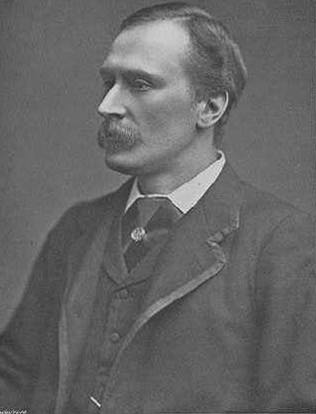
Michael Maybrick
alias Stephen Adams, 1880s photo
2:
Poisoning an Arsenic AddictThe
question of a Masonic meaning to this ballad was raised by the Australian composer
and writer Derek Strahan in a fascinating internet piece
on Michael Maybrick,
his collaborator Frederick Weatherly and their possible
gay and Masonic links. The name of Maybrick was associated with a poisoning
during his lifetime when his American-born sister-in-law, Florence was convicted
of murdering his brother James. The case is thrown in doubt by the fact that James
was an arsenic and strychnine addict, taking the poisons as supposed sexual stimulants,
though the court did not hear of this. Michael played a major part in the early
accusation of Mrs Maybrick, placing her under virtual house-arrest while his brother
lay dying. Today the case is regarded as a study in Victorian double-standards,
Florence's extramarital affairs making her a convenient scapegoat, though her
unfortunate decision to brew home-made cosmetics from arsenic fly-papers seems,
if anything, even more puzzling today than it did at the time. The
poisoning was lurid enough but worse was to come. In 1992, a book was published
which purported to be the secret diary of Jack the Ripper, pointing the finger
at James Maybrick as author. This book, connecting the major shock-horror story
of 1888, Jack-the-Ripper, with that of 1889, the Maybrick poisoning, seems to
have been an elaborate hoax &endash; the two stories have often appeared in sequence
in popular crime compilations. Derek Strahan's account is valuable for being fleshed
out with some family reminiscences from his friend Amanda Pruden: Michael Maybrick
was her Great Uncle. Michael and Fred Weatherly, both Freemasons were held by
the family to be a couple, though both were married, Michael somewhat late in
life.
3:
Adam & Steve Milk the Royalty System The
Royalty Ballad system meant that publishers promoted their songs by paying singers
a royalty to include them in concerts and naming them on the sheet music covers
by way of a seal of approval. In a way the ballad concerts played the promotional
rôle that records would later play, the aim being to sell the music to amateurs
for home performance, a very substantial market. The system arose during the 1860s
and the name Ballad Concert first appears in the 1870s. Boosey & Co. were
probably the leading publishers in this line, though Chappell and Metzler were
not far behind. Michael Maybrick arrived on the London scene in the mid 1870s,
adopting the name Stephen Adams as a writer of material which was sung by himself
and others, notably the tenor Edward Lloyd. The sheet music notes many songs as
being by Adams and sung by Mr. Maybrick so it is not entirely clear how many were
aware of the pseudonym. If this made-up name seems to trip off the tongue, could
it be that the spelling disguises (St)Eve 'n Adam(s) at its core? There are of
course some advantages to being listed at the top in advertisements of songs in
alphabetical order. Or is the preacher's quip about Adam & Steve not quite
so recent as we had thought?
4:
A Rough Trade in Angels Heterodox
religion is rife in the Victorian semi-sacred song. The trade in lyrics was an
industry, with the authors advertising their services in periodicals, boasting
of their fecundity. The cloister-song with angelic singing children snatched away
by angels for being too sweet is a standard form. This period marked the height
of the Oxford Movement of Puginesque Churches, of William Morris Stained glass,
of mourning jewelry. Though it is generally held that the Victorian Ballad had
nothing but the name in common with earlier traditional poems, some points of
contact are clear. The ballad would not entirely shake off its supernatural history
and many of the songs are about some kind of epiphany, often giving a religious
twist to a phrase already heard e.g. "safe in his Father's arms". To
establish any occult strands in the Weatherly-Adams songs we would really need
to pit them against control specimens from other writers to see if they stick
out of the pile. That would be a daunting task. Weatherly was massively prolific
and claimed to have penned some 3,000 lyrics. As a copyright lawyer he was no
doubt in a better position than most to defend his work against the pirates who
made such inroads against the legitimate publishers until an effective Copyright
Act in 1906. Derek Strahan estimates that Adams-Maybrick probably wrote about
a hundred songs in all and, in collaboration with Derek, I have compiled a list
of nearly 70 titles from the
backs of old sheet-music. Yet it turned out that Derek was not, after all,
the first writer to detect layers of arcane meaning in these old ballads. Before
I name the man who got there first, however, I want to take a closer look at The
Holy City to see if it is Christian, Masonic or both. Then to look at a possible
source.
5:
The Cross in the Margin A
first reaction to The Holy City is to feel it is more sentimental-Christian than
Masonic. There is mention of the Cross and Hosannas to the King, even if Christ
is not named. The children's choir is a mainstay of the ballad at this period.
Here they are given the famous cry of the Crusader's on seeing the city: Jerusalem,
Jerusalem! On
the other hand, the Cross is evoked in a manner which suggests that its mystery
and shadow are dispelled by the shining and regenerated City. The Cross in the
old pilgrim maps, is seen as outside the Temple Walls and here also it could be
said to be marginalized. The light of God which denies no one is not any normal
Christian Apocalypse which would involve a Last Judgment. The identification of
God with light also fits with a tradition that, for the highest degree Masons,
the Temple of Solomon is no more than a pun on three names for the Sun-God, Sol-Om-On. Semi-religious
ballads were not of course hymns and were not submitted for approval to the Church
authorities. As expressions of popular feeling, it is unlikely they were scrutinized
for heresy, though stern critics like Shaw viewed them as tasteless twaddle. In
so far as they are religious, the religion normally tends towards the Catholic
in its visions of the heavens opening to admit orphans who are too good to live. This
Jerusalem as Centre of the World is a potent image and a mysterious place in the
mind. It appears at the end of Verdi's I Lombardi, where the distant city is viewed
through the flap of the tent, as if a veil is torn. In that score, miraculous
fountains spring up to accompany the vision. That opera was actually renamed Jerusalem
when it was extended for the Paris Opera. Read
the rest of the story
MAYBRICK
WAS A WICKED MANMichael
Maybrick's story lay dormant until 1992, when a diary purportedly kept by his
brother, James Maybrick was discovered: in it, James Maybrick identifies himself
as perpetrator of the arch-notorious Whitechapel murders of 1888 committed by
Jack the Ripper. While has the diary been challenged as a forgery, the attention
it gathered took James Maybrick's name to the top of the "Ripper" suspect list.
It also
focused concentration on the role played by Michael Maybrick in helping send his
brother's widow to serve an unjust 15-year prison sentence for James Maybrick's
alleged murder by arsenic, an event vaguely alluded to in James Joyce's novel
Ulysses. These unsavory elements do not serve the reputation of Michael Maybrick
well, but they lend interest to his story, which was otherwise of no concern to
musicologists.
http://www.mmguide.musicmatch.com/artist/artist.cgi?ARTISTID=1081423&TMPL=LONG#bio
LINKS: http://www.revolve.com.au/polemic/adams_profile.html This
link shows again the wicked side of Maybrick. Sample
from the site: "Finally,
a mention for arguably the best-remembered ballad composer of all, Stephen Adams
(1844-1913) whose real name was Michael Maybreak. A Liverpool-born baritone singer,
he soon began composing songs of his own and The Star of Bethlehem, The Holy City,
Thora and Nirvana among many other titles achieved enormous popularity. They can
even be heard today. Songs need words, of course, and "Adams" established a profitable
partnership with barrister Fred Weatherly (1848-1929) who wrote possibly 3000
song lyrics for many composers besides Adams, Eric Coates, Henry Trotter and Wilfrid
Sanderson." Although
the journal which came to light in 1993, purporting to be written by James Maybrick
during the period of the murders, is still regarded as suspect, it has not yet
been conclusively proved to be a fraud, and one of Britain's foremost Ripperologists,
writer Colin Wilson, now regards Maybrick as the most credible candidate. But
our focus today is on the impact James Maybrick's misfortunes had on the life
of his brother, Michael, a hugely successful composer of light music. I've mentioned
that my interest in Michael Maybrick arose from my own close association with
my friend Amanda, whose great-grand-uncle Edwin Maybrick was the youngest brother
of James and Michael Maybrick. I've also mentioned the family mythology regarding
Michael, that he had a long-term gay relationship with his librettist, Fred Weatherly,
who was also a London barrister. Michael's sexual orientation is obliquely referred
to by Shirley Harrison, author of the 1993 hit "The Diary of Jack the Ripper",
in which she provides brief but valuable biographical insights to Michael's life,
albeit revealing little sympathy for Michael himself. The narrative picks up in
1893, 3 years after the trial of Florence Maybrick, and suggests that it had become
too difficult for Michael to maintain his social and musical life in London. According
to Amanda's family mythology, by then Michael and Fred Weatherly had parted company.
The
Story of Florence Maybrick
This
includes the description of how Mickael Maybrick abused Florence. Jack
the Ripper Students consider Michael Maybrick was possibly Jack the Ripper The
Florence Maybrick Story-- Second version
CONCLUSION--
By Steve Van Nattan From
the above research material, which was greatly inspired by research done by Robert
Aseltine, we see that "The Holy City" was nothing more than a very early
version of Contemporary Christian Music. Satan has been hard at work slipping
his works into the Lord's Church. It
is obviously an evil song and should not be performed by Bible believers. What
else can we say? This song also shows how a tradition of singing songs can develop
simply because they sound good or move the masses of listeners. Are you doing
your homework on the music you sing and use in your fellowship? Robert
Aseltine, who contributes regularly to prod us to examine issues, was composing
a medley for organ of several old respected hymns. The person asking him to arrange
the medley suggested several hymns, including "The Holy City." Bob at
first was pleased with the selection, but "The Holy City" made him uncomfortable,
so he did some digging into the history of the song. That is where this article
began-- In Robert's research. Again, are YOU doing you research?
________________________________ 2014
update: Robert
Aseltine went to be with the Lord in about 2003. He and I served as chaplains'
assistants in the US Army at Fort Knox in the late 1960s, and Bob had a quiet
intense faith and testimony then. He stayed on the narrow way until his death.
I am told a man has about eight very close friends in his lifetime. Bob was one
of mine, and he was the kind of friend who held himself and his friends to a high
standard, not of works related rubbish, but to exalt Jesus Christ and review all
of life with an open Bible. Look him up when we all get to heaven.
BACK
TO MUSIC PAGE BACK
TO WAR ROOM BACK
TO ENTRY PAGE OF JOURNAL GE |
