|
|

HOME
- TABLE OF CONTENTS
- WAR ROOM -
THE GOSPEL
- BIBLE
STUDY - MORAL
ISSUES - KING
JAMES BIBLE - CULTS |
|
Eastern
Mysticism in I have seen and heard of a good number of saints in Baptist, Fundamental, and Bible believing churches who send their sons to Karate classes. Bob Jones University has a Karate team that runs to churches where they read the Bible, then bust bricks with their thick skulls, all in the Name of the Carpenter of Nazareth. [Now, there is something in that which ought to be developed further I think.] Along with this, I hear of church men and pastors running through the woods "killing" each other by shooting jelly balls at each other with special guns. Stalking and war strategy are now the order of the day. SICK, all of these men are sick. |
This
is as unlike Jesus as any of the antics of the scum that lead the show at Brownsville
and the Toronto Blessing. I intend to hit this very hard, and I invite the
testimonies of those who have been enslaved with the devils of Eastern Martial
Arts and have been delivered.
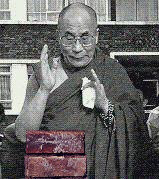
Dalai
chop

Karate
Tool for Christian Evangelism or Zen Buddhism?
On the cover of Bob Jones University's Spring 1992 issue of the BJU Review is a picture of black belt karate master and senior at BJU, Jim Pitts, in full karate garb, Bible open, giving the "invitation," while the rest of the members of BJU's "Champions for Christ karate team" are kneeling in prayer by their cinder-block bricks. On the inside cover is a picture of Mr. Pitts breaking four bricks with his right arm, while the other team members are watching, with Bibles open.
The editor of the Review declares that "Champions for Christ is one of many different extension groups that go out from the University each week, bringing the Gospel to needy people throughout the Southeast. These extension ministries give all students the chance to sharpen their soul winning skills, be an encouragement to others, and use their skills to glorify God." (Emphasis added.)
Many other so-called youth and evangelism ministries promote the martial arts as a means of motivating youth in evangelism, spiritual warfare, etc. For example, the March 1992 Baptist Bulletin (GARBC) contains an article about a husband-wife ABWE missionary team helping "teenagers understand God's power in their lives" by exhibiting his (the husband's) karate skills ("such as breaking boards with his hands and demonstrating samurai swords and nunchakus") at GARBC youth rallies. The missionary team claims to want "to help the teenagers understand God's power in their lives … [and] to motivate them to join God in the spiritual battle of the present age."
Should a Christian's "soul winning skills" include karate, and can that "skill" be used "to glorify God?" And what has karate to do with the reality of "God's power" in a teenager's life? Even though one might find it difficult to see how the so-called "skill" of karate could or would be used by the Holy Spirit to draw the lost to Christ, the over-riding question must be: Is there a philosophy antithetical to Christianity that is at the root of karate exhibitions?
Karate has a unique and unusual history. It was handed down centuries ago from Zen Master to Buddhist monk by word of mouth, and always in strict secrecy. Even today, everything done in karate can be tracked back to some principle of Zen Buddhism. An Indian Buddhist priest named Bodhidharma in the 6th century A.D. in China, synthesized karate techniques and Yoga meditation in order to unite mind, spirit, and body. (Among the Chinese styles are kung fu, or gung fu, wu shu, and pa kua. Tai kwan do and hapkido are among the Korean styles.) Karate is clearly a mental and moral exercise, indeed, a spiritual experience. In each practice session there is a concerted effort to unite mind, spirit, and body just as Bodhidharma sought to do with Zen priests.
Karate is founded on scientific principles of body movements that develop the karate devotee into a healthy, well coordinated person, both physically and mentally. The Chinese karate masters considered karate to be an extension of their religion. The Okinawan karate masters considered it to be a way of life: "It is, rather, an expression of life lived 24 hours a day, 365 days a year. Indeed, the way of karate is a philosophy of life-a rich, rewarding philosophy if carried through, past the boundaries of obvious self-defense techniques, into the realm of mind-searching discipline. Within karate-do is the potential of a new person: a person huge in all the capabilities that will make him respected and confident." (The Way of Karate)
Karate is Zen-so says Master Oyama and many other karate masters. Zen is a school of Buddhism that has been called the "Religion of Immediate Reality." The aim of Zen is to awaken the student to his true self and thus bring about a degree of self-knowledge through inward meditation. Zen students seek peace of mind through an enlightened awakening of an intuitive wisdom, which they feel is dormant now in all people. Zen meditation tries to achieve "no mindedness" which may be acquired by concentration and special breathing exercises. Karate, when combined with Zen meditation, is used to assist the student's quest for peace of mind and equanimity in the face of conflict and tension.
Although many, especially here in the United States, tend to disregard much of the Zen Buddhist philosophy in their training, some impact of that philosophy is made upon every student of karate. This is because Zen meditation and yoga-like breathing exercises-whether for thirty seconds or for two hours before and after every practice session-are an integral part of any Oriental martial arts program. If one truly aspires to master the art of karate he cannot ignore the spiritual implications.
Zen meditation provides a false "inner peace" that is at best a counterfeit of the peace only God can give. There is only one source of inner peace-the Holy Spirit (Galatians 5:22, But the fruit of the Spirit is love, joy, peace, longsuffering, gentleness, goodness, faith, ). We can choose between the self-control developed by the Holy Spirit, or the self-control of Zen. And with the self-control of Zen, as with any Eastern meditation technique, one could also be opening himself up to demonic activity.
While God calls us to humility, the martial arts cater to human pride. For even in gaining mastery over one's self through Zen, it is still recognized as an accomplishment of self. That self-pride then manifests itself through a desire to prove oneself superior.
- Although some proponents for a "Christian" martial arts do concede that karate has roots in occult, pagan, and/or Eastern religious philosophy, they also claim that the primary philosophy behind the martial arts actually originated in Old Testament Biblical times (citing such passages as Gen. 14:13-16; 2 Sam 6:14; Psa. 144:1; Eccl. 9:10 as proof-texts), even going back all the way to the Garden of Eden! (Christian Martial Arts, Tottingham & Tottingham, pp. v & 2). Therefore, according to these advocates, Satan made "inroads" into the true Bible-based martial arts, capturing them for himself, and that all we need to do now is to reclaim them and change them "from an Asiatic philosophy to a truly Bible-centered Christian philosophy" (Christian Martial Arts, pp. ii & 2). Once these "dramatic changes" in "approach" are made, we are told, the "Christian can indeed study the martial arts in total harmony with his walk with the Lord" (Christian Martial Arts, p. v).
This, of course, is the same logic men use to "Christianize" any worldly, pagan, and/or occult philosophy or practice, whether it be astrology (the "Gospel in the Stars"), psychology, Eastern "medicine," magic, pyramidology, graphology, numerology, etc., etc., etc. The logic goes something like this: "It was originated by God (which requires a few verses out of context to 'prove' it), Satan stole it and/or counterfeited it (under the false assumption that 'Satan can't create, he just steals from God'), we need to reclaim it and re-Christianize it, and then we can use it to glorify God'" (Christian Martial Arts, pp. 75, 83).
- The violence associated with karate smacks of anything but "Christian." Legendary karate "masters" were reputed to have superhuman powers, including the ability to kill small birds with a yell ("the shout of doom"), a secret knowledge of how to touch lightly at a spot on the body to cause death ("the touch of death"), and the ability to penetrate an adversary's body with a bare hand to withdraw his still-beating heart. The very nature of these violent forms of expression runs counter to God's Word.
- How then can any Christian justify his involvement in karate or any of the other martial arts? He can't. Not even by claiming that such involvement is for self-defense, exercise, to learn discipline, etc. (let alone justifying it for evangelism purposes!). There are other methods by which these results may be obtained-methods not associated with harmful violence and false doctrine.
* The chief source of our information for this report was a special report written by Albert Dager of Media Spotlight, P.O. Box 290, Redmond, WA 98072. Other sources used were various encyclopedias and three books on karate/martial arts, The Way of Karate, Karate Within Your Grasp, and Christian Martial Arts.
Biblical Discernment Ministries - 4/92
http://www.umc.org/site/c.gjJTJbMUIuE/b.947107/k.8579/Haiyaah_Pastor_uses_karate_for_Christ.htm
http://www.tbcboston.org/ministries/karate/karate.htm
Here is a perfect fool who uses Karate to teach Christian truth.
This is the untimate of spiritual insanity
KARATE AS IT REALLY IS
The
beginnings of modern-day karate date back to 560 AD when Daruma Boddhidharma,
the founder of Zen Buddhism, left western India and traveled thousands of miles
alone to teach in China. He found many students eager to listen to his ideas but
physically unable to keep up with him. So he designed a method of training to
develop his followers' physical strength, which he considered a crucial aid in
attaining spiritual strength. His reasoning became the basis of karate-do, or
"the way of the empty hand." Although he felt that the way of Buddha was preached
for the soul, he taught that "the body mind and soul are inseparable."
http://web.mit.edu/shotokan/gen_info_shotokan.html
_________________
The
distinguishing characteristic of martial arts ,including Kyokushin Karate , is
the central role accorded spiritual. The discipline of Kyokushin Karate in particular
demands that the practitioner push the bounds of his or her phisical and mental
abilities to expand the individual's self-knowledge and spiritual awareness.
http://www.geocities.com/irek65/supreme.html?953116289120
_________________
The
"do" suffix is used for various arts and implies that they are not just techniques
but have spiritual elements. In this circumstance it is usually translated as
"the way of" (cf. Aikido, Judo and Kendo). Thus, "karate-do" is "the way of the
empty hand". Wikipedia
_________________
The
meaning and sprit of TRADITIONAL KARATE comes from the history of the Island of
Okinawa, Japan - the birthplace of Karate. The roots of Karate were brought to
Okinawa by Masters that traveled to China to learn the Martial Arts. It is believed
that a Buddhist Priest, Bodhidharma, developed the first self-defense techniques
within the walls of the monastery in China. In this quiet, meditative atmosphere,
Karate became a way of life, a spiritual discipline, with a code of honor. Fundamental
to this code of honor, non-violence and respect are central to the teaching found
at the Authentic Ancient Arts Karate and Kobudo Studios.
http://home1.gte.net/neilsaaa/karate_history.htm
_________________
While
it can be said that there are certain groups in the United States and Europe that,
with the objective of understanding the soul of the Orient as a means of counteracting
the impasse arising from materialistic civilization, place emphasis on the spiritual
side of karate, the sad truth is that many styles teach only the fighting art
and neglect the spiritual aspects. Where is the spiritual aspect of karate? Surely
karate can be an extremely effective self-defense system, but I believe this is
a subproduct, I do not believe this is the real objective of the art. But for
our mental structure it's much easier to understand things that clearly prove
their usefulness, but this hardly represents the art's real purpose. Master Egami
expresses his concern in another part of the text, stating that Karate-do cannot
be viewed as an "art of homicide". If this is to be avoided, instructors must
not teach it in such a fashion. In any case, this is just another typical manifestation
of our pragmatic and utilitarian mentality that is noticeable by its lack of spirituality.
The East is illogical, irrational, unreflexive, intuitive, affective, non-discursive,
non-pragmatic, integrative, deductive, non-individualistic and thus, socially
group-oriented. It is not philosophical nor speculative, it is religious, it is
profound, it is spiritual. This expresses itself through cultural manifestations
that are linked to this spirituality. That is why the Budo martial arts and Karate-do
are a representative part of this spirituality, that points, through training
and practice, to the most profound aspects of our being. Who will be the next
one that will give his life so that we may understand something about the Way.
http://www.shotokai.com/ingles/filosofia/whowill.html
_________________
The
spiritual and mental aspect is getting less and less. This has happened as karate
has become more popular and taught in more and more places. People are just taking
karate as a kind of exercise, for self-defense, as a type of aerobic exercise
that is also good for a diet. Others just see a flashy way, or way that looks
good, but the mental spiritual aspect is getting less which I think now is a very
dangerous situation. This means that while there are now many karate dojos, or
schools, available, the instructors, what we call shidosha or sensei, are teaching
only karate, but not karate-do. This is the big difference compared to the past.
My experience is that karate should be for, not just how to fight or defend yourself,
but it should also be more rounded to include mental and spiritual aspects. Particularly
what we call traditional karate should include physical, mental, and the spiritual.
http://www.fightingarts.com/content01/nakamura.shtml
_________________
We
utilize the philosophy of mind-body-spirit and help members to learn to control
their minds when they train and to tap into their physical and spiritual (Ki or
Chi) energy. http://aika.i8.com/
_________________
Karate-do
for Otsuka Sensei is primarily a spiritual discipline.
http://www.hillmanweb.com/karate.html
SHOTOKAN KARATE
GICHIN
FUNAKOSHI
Founder
of Shotokan Karate 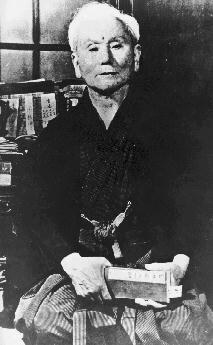
NIJU
KUN--
This is the philosophy of Gichin Funakoshi:
Notes by your editor in blue.
* Karate is not only dojo training.
[
It is also some other mystery, and you can be sure it is NOT the mystery of godliness.
]
*
Don't forget that Karate begins with a bow and ends with a bow.
[
Bowing is worship in the Bible and in all religion. To which Lord do YOU
bow? ]
*
In Karate, never attack first.
[
But, eventually you can justify attack. This is NOT, "Love your enemies.
]
*
One who practices Karate must follow the way of justice .
[
Without Christ, no human invention brings justice. ]
* First you must know yourself.
Then you can know others.
[
"Know thyself" is ancient humanistic philosophy and is repulsive to the saint
who wants to "know Him and the power of His resurrection." ]
* Spiritual
development is paramount; technical skills are merely means to the end.
[
Ah. but which spirit? In this case, we KNOW that Buddhism is the spiritual
source. ]
*
You must release your mind
[ Here
is demonic doctrine found in ALL cults. Empty your mind, don't resist the
spirit. Let the river flow. From the New Age to Witchcraft to the
Charismatic Movement this prevails. God says, "Come now. let us reason together..."]
* Misfortune
comes out of laziness.
[ "Misfortune"
comes from the Greek goddess of fate, Fortuna. The Bible teaches that judgment
comes from laziness. ]
*
Karate is a lifelong training.
[
Commitment is for life, as in the Gospel. ]
* Put Karate into everything
you do.
[ This guruistic advice
implies that Karate is to prevail over Christ. ]
* Karate is like hot water.
If you do not give heat constantly it will again become cold.
[
The warm of Karate comes from fire. The life and warmth of Bible Christianity
comes from light-- Jesus Christ. ]
*
Do not think you have to win. Think that you do not have to lose.
[
Paul said he suffered the loss of all that things that he might win Christ. A
true saint is seeking always to win the crown of life. The problem with
karate is that it pits man against man. New Testament Christianity pits
the new man against his old nature with provision made to be a winner EVERY time
without competing against another saint. Karate is cheap combat. ]
* Victory
depends on your ability to tell vulnerable points from invulnerable ones.
[
So in Karate, victory depends on stealth in the user. A Bible believer
depends on his victory on Christ. If you have two departments for faith,
one in you and one in Christ, you are a double minded man and unstable in ALL
your ways.]
*
Move according to your opponent.
[
The opponent of Bible saints is Satan, not man. The Bible saint learns to
do good to his enemies. ]
*
Consider your opponent's hands and legs as you would sharp swords.
[ The Sword of the saints is the Word
of God, not some human's legs. ]
*
When you leave home, think that millions of opponents are waiting for you.
[
When you leave home, think that He (Christ) is your shield and buckler. This
Karate is cheap low life thinking. It is pessimistic and negative. ]
* Ready
position for beginners and natural position for advanced students.
[
The natural man in the Bible saints is to be crucified with Christ. The
new man lives unto eternal life daily. ]
* Karate is one thing. Engaging
in a real fight is another.
[
So, violence is the ultimate objective of Karate. This is the opposite of
seek peace and pursue it. This mocks at a soft answer turneth away wrath.
]
* Do not forget (1)strength and weakness of power, (2)expansion and contraction of the body, (3)slowness and speed of techniques. [ This technique depends on physical strength with profiteth little according to Paul. This is meat and muscle when the saint is to be living in the spiritual plane of expectation and battle with Christ. ]
*
Devise at all times.
[ Devise
what? Tricks? This filthy exercise prepares the man to be like a coil
spring of massive destruction at all times. Jesus said, "Blessed are the
peace makers..." Why not be always poised to cause peace in this world?
Is that out of fashion? If this perpetual preparation to attack appeals
to you, you are NOT a child of God, you are a Buddhist bigot. ]
You cannot have this philosophy and the Gospel of Jesus Christ. Each one virtually excludes the other.
MARTIAL ARTS
By
Rev. Ewald Eisele
Religion Analysis Service
In this particular class the ages of the pupils include ages 8 to 35 or 40. They are here to learn Karate. The children are concentrating just as much as the older "students." They are led through the various kicks, punches and jumps by an oriental man, who at the beginning of the class, led the entire group in bowing to the two flags at the front of the long, rather narrow, hall. One was an American flag and the other an oriental flag with some kind of oriental configuration on it.
What this group, and thousands of others like it around the country, is doing, is learning a system which was born two centuries before the birth of the Christian era and developed in various eastern countries. It is called a Martial Art because it is part of a group of similar systems that were originally considered a form of weaponless warfare. An encyclopedia definition states that Martial Arts are methods of self-defense based on Eastern philosophies or religion.
There are 56 varieties of Martial Arts, some violent and others more passive. All are disciplines designed to harmonize the body with the energy forces of the universe in order to achieve religious enlightenment. There are six to eight major disciplines.
KUNG FU was the original term describing the Martial Arts. Later, specific names were given to variations: Karate, Tai Chi. Judo, Jujitsu and Aidido. The original religious philosophy of Kung Fu dates back to 2696 BC. This discipline is the "hard school," emphasizing kicking, striking and punching. Its appeal to the average person lies in its offensive character, although it can be used to improve health. Advanced Kung Fu is used for striking vital points, causing delayed action of some sort that is known as a "death touch," and the use of psychic powers. Most practitioners do not consider Kung Fu to be a religion but rather a way of life. However, since many of its philosophies are adapted to everyday life, it then becomes, for all practical purposes, the personal religion of the adherent. Most "sifu," or Kung Fu teachers, will admit that anyone can learn the perfect physical aspects of the art but that the inner teachings are much more important.
TAI CHI is that form of Martial Arts in which the ultimate goal is readily admitted to become an immortal. This is supposedly accomplished by putting the body in harmony with the laws of nature. This form of the art can produce supernatural strength and devastating power in combat. This is brought about by concentrating on the KI or CH'I, known in the occult arts as the ''life-energy-creative force" of the universe. This is the source of power for all that is done in the Martial Arts. In a practitioner, this center of power, or KI, is located in the body's psychic center just below the navel. [Editor: Balaam's Ass Speaks- This is the same point the Hindus call the Kundalini chakra, or the sexual life force.]
KI is developed by meditation, concentration, and the fundamental exercise of abdominal breathing. This doctrine was the main source of metaphysical and intellectual speculation for Indian, Chinese, Tibetan, and Japanese philosophers and religious leaders. It was ultimately adopted by almost all the important schools of Martial Arts. It is not considered mysterious or magical but rather a common property of every human being. The difficult part is learning how to master it and release it profitably. It can produce effects not only within the body but also at a distance from the practitioner. It is claimed that this KI energy can be used to turn the hand into a powerful weapon, to heal wounds and diseases, or break bricks and boards without even touching them. It can be used as a shield to keep the individual from being injured. A Martial Artist can so direct the KI power that no matter how many blows he might receive, whether from fists, staves, or even swords, he will not even show a bruise or scratch on his body.
One who has mastered the art is able to strike a pile of bricks, for instance, with just a slap, and break only one pre-selected brick in the pile. This energy, it is claimed, can be used to concentrate all available KI into a loud shout which, if so desired, can actually kill an opponent. On the defensive side, a man knowledgeable in the techniques of K1, can, through concentration and meditation, be completely indifferent to physical discomfort, pain, and even death.
Without doubt, if these things real]y do take place, and there is no reason to doubt the claims made for KI, the power is not of God but of the occult and Satan, who is behind all occult phenomenon.
KARATE is that form best known to westerners. To be successful, one must first empty the mind of wickedness in order to react in an acceptable way to the "internalized god." Because of the nature of the development of Karate in its background of Buddhism, even when it is not stressed by the instructor, the art is saturated with Zen philosophy.
Zen is a Buddhist discipline that stresses meditation and direct teaching from master to student. It was introduced to China by a Buddhist monk who had studied Buddhism in India. While Buddhism teaches that it takes a lifetime to "arrive"at an "awakening," Zen teaches that the goal may be reached immediately. The aim of Zen is complete control of the mind to attain a state of enlightenment and a sense of detachment from the physical world. This is the one essential of Zen: the direct experience of enlightenment. Encouraging, deepening, and expressing that experience in all of life is its sole purpose. In Zen there is no past nor future because the most important thing is the experience of the "now" or present moment. Zen has no concept of sin, has no god, and so needs no deliverance. It is generally acknowledged that Zen was the foundation of the Martial Arts in Japan and that it reputedly provides the Martial Artist with the disciplines for developing strong character and personality. Zen Buddhists say, "When sitting correctly in Za-Zen one is not practicing towards becoming the Buddha: while sitting correctly, one IS the Buddha."
According to THE OFFICIAL MANUAL OF THE JAPAN KARATE ASSN., which was written by their Chief Instructor, M. Nakayama. "Karate is, and always has been, a method of self defense, never a technique of aggression. But it is much more than that. To the sincere student, it is a form of combined physical and mental discipline from which he can learn the value of personal attributes such as kindness and sincerity." Gichin Funakoshi, the man who introduced karate into Japan, often told his students, "The spirit of karate is lost without courtesy."
JUDO and JUJITSU. Jujitsu is a blend of Rung Fu and Japanese martial arts. Judo is basically Jujitsu minus the killing aspects. It was the first, according to THE COMPLETE MARTIAL ARTS CATALOGUE, to reach outside the Orient to the Western world, where it became at first a fascinating, secretive fighting art and later an internationally recognized sport. By the beginning of World War II, there were judo schools in almost every major country, and following the war, it became a recognized Olympic sport.
Devotees are warned in some judo manuals that the art should not be learned without the inclusion of meditation exercises. The "Catalogue" quoted above states that the founder of judo, Jigoro Kano, taught that the ultimate goal of judo was, "The harmonious development end eventual perfection of human character."
These are some of the different forms of Martial Arts but all have similar religious backgrounds and goals. Since their roots are in Taoism and Buddhism, they view the universe as an interplay of opposites expressed in eastern philosophy and religions as the YIN and YANG. The goal is to arrive at the Zen goal of stilled senses where one is able to merge with the "Universal Consciousness."
Almost without exception those involved in some kind of Martial Arts training complain about anyone finding fault with the Arts because all they want to do is learn self-defense or physical prowess. Matsutatsu Oyama, who in 1947 won the All Japan Karate Championship, came to the United States in 1952 to represent the Karate world of Japan. He wrote in his book, MASTERING KARATE, "Always more vital to karate than techniques or strength is the spiritual element that lets you move and act with complete freedom. In striving to enter the proper frame of mind, Zen meditation is of great importance. Though we say that this meditation involves a state of impassivity and complete lack of thought, we mean that through meditation we can overcome emotion and thinking and give freer reign to our innate abilities than ever before. The Zen style of selfishness is the same condition of disregard for selfish thoughts and concern for personal welfare that the artist experiences in the heart of creation. The man who wants to walk the way of karate cannot afford to neglect Zen and spiritual training."
A few would argue that a person does not study the philosophical or religious aspects of the Martial Arts but only the physical. People that argue that way must hear American 5th Dan Master Instructor, Bob Miller, who initiates boys as young as five years old into his own free-style version of Hapkido, which is a Korean Martial Art similar to "soft style" karate. He said, and this is quoted in MARTIAL ARTS -- ARE THEY HARMFUL, by Mike R. Taylor available from Religion Analysis Service, "While I teach them on the physical level, I throw philosophy at them." It would take an unusual individual, who possessed a great amount of discernment to try to sift the physical benefits out of a Martial Arts program and not be affected in any way by the philosophical, occult or spiritual. Alter all, the power for KI is not of God so it must be of Satan, and is not something with which a Christian should have anything to do.
VIDEOS
All karate but this kind is demonic
"Its mysterious godly techniques"
Once you master it, you are a walking lethal weapon.
Ask yourself if this is like Jesus Christ.
Are there alternatives?Karate IS a spiritual exercise to its masters,
even it diddle head Christians don't think so.Mixing two spirits?
LINKS:
From what I know of Karate - The ritualistic patterns of motion are rooted in Semi mystical Taoist philosophy, not to mention synchronized breathing is a key to both Buddhist and Hindu meditation. I've heard that Christians aren't "meditating"... but still... Isn't this like taking something pagan and repackaging it as Christian? Also, while in church, the Karate speaker didn't come out and say the Ying Yang, but he did say the black dog, versus the white dog...
Sounds to me like yet another one of satan's attempts to dumb down the churches, and they're falling for it, hook, line, and sinker. For a long time now, churches have become more and more, primarily nothing more than social clubs, and this is just another rung on the social ladder for these churches. Can't you just see Jesus, announcing to the crowds, telling them how "starting next week, we're going to start classes in karate and all kinds of martial arts after this kicks in." Someone (at least one) will say how "the roots are from the Eastern religions, false gods, those who hate You, ect." Then Jesus replying, "oh, but don't think of it like that, ignore the pagan roots, and just look at it as learning self defense, getting good exercise, ect. Yes, I know I told you that you're not of this world, and you're not to take part in things of the world that go against me, but this is different. We'll just put a new spin on things and call it all Christian, and all will be fine." Can't you just see Jesus saying all this? I don't think so! Jesus never used gimmics and entertainment to reach the lost, nor did His diciples, but today's churches do, and have for a long time and it just continues to get worse and worse, and there's no telling what will enter our churches next.
Blessed are the meek (gentle) for THEY shall inherit the earth. Matt 5:5
Blessed are the peacemakers for they shall be called SONS OF GOD. Matt 5:9
http://www.rr-bb.com/showthread.php?t=190381&page=1&pp=25____________________________
Karate is a religious system, which maintains its links in a variety of ways with the Eastern religious practitioners who spawned it. These links include widely available books, visiting and resident teachers, idols and terminology and the same exercises designed as meditative techniques which worked to develop occultic powers. On the basis of the jealousy of God, it is illegitimate for His people to participate in this crass paganism.
http://www.rcnz.org.nz/resources/fnf/ar8.htm"Central Resource for Mushindo Studies"--
Mushindo exposed by former members:
http://www.escalix.com/freepage/mushindo/Bodhisattva Warriors:
DISCUSSION OF BUDDHISM AND MARTIAL ARTS: http://www.bodhisattva.connectfree.co.uk/THIS TAOIST SITE PROVES THAT
THE MARTIAL ARTS IS SHAMANISM AND AN EASTERN CULT:
http://www.teleport.com/~mkmcconn/calvin.htmlMARTIAL ARTS PROMOTERS BELIEVE IT IS RELIGION:
http://www.accessnewage.com/links/link18.htmQIGONG-- Books from China-- Start a new martial arts
religion in your Baptist church:
http://www.chinabooks.com/Catalog/martart.htmlSPIRITUAL SIDE OF MARTIAL ARTS DEFINED IN SWEDEN: http://kyojutsu.rug.ac.be/bujinkan/u17inner.htm
TAKE A SPIRITUAL / MARTIAL ARTS / BUDDHIST TOUR OF CHINA: http://www.waveconcepts.com/4winds/china/
HANTA YO-- SCHOOL OF CONSCIOUS MOVEMENT Hanta Yo is a Lakota Souix term that means "clear the way". It indicates the intention of drawing on the Great Spirit to clear the way while you do your part with faith. All mystical, conscious work, including yoga and the Martial Arts, are about "plugging in" to an infinite source of creative potential. Techniques vary but the goals are identical: to conduct the life force more dynamically through the body/mind of the human being. http://gnv.fdt.net/~taohouse/hysocm.htm
PURE PAGANISM-- Karl Geis & The Fugakukai International Association THE SPIRITUAL ASPECT OF THE MARTIAL ARTS: http://www.karlgeis.com/spirituality.htm
PROVING KARATE ET AL ARE SPIRITUAL--
Physical, Mental and Spiritual Fitness Through Martial Arts:
http://www.ohtc.com/art.lang1.htmlLONG LIST OF MARTIAL ARTS SITES: http://www.best.com/~akeem/malink.htm
Religion Analysis Service:
They have several articles you can order on Martial Arts: http://www.wwy.org/ras/
BACK TO WAR ROOM- General Wickedness
BACK TO ENTRY PAGE OF THE JOURNAL
GE