Searching for the Truth in the King James Bible;
Finding it, and passing it on to you.
EDITOR:
Steve
Van Nattan
SEARCH
THIS JOURNAL |
|
|
HOME
- TABLE OF CONTENTS
- WAR ROOM -
THE GOSPEL
- BIBLE
STUDY - MORAL
ISSUES - KING
JAMES BIBLE - CULTS |
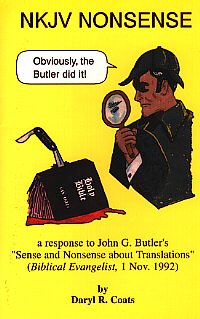
NEW KING JAMES VERSION NONSENSEBy Daryl R. Coats
From the Editor, Blessed Quietness Journal, Steve Van Nattan: The following book was written in response to heretical attacks on the King James Version 1611 by John G. Butler of the Biblical Evangelist. Butler does the usual trick of claiming he loves the good old KJV, then he promptly trashes it. Brother Coats has blessed us with a very timely discussion of Butler's attack on the Word on God. This boot is Copyrighted in 1992, reprinted 1995, and any use of it must be by his permission, which we have. I am sorry we were not able to give you the Greek and Hebrew words illustrated in the book. You could get them by ordering a copy from the address below.
NKJV Nonsense
By Daryl R. Coats
© 1992 bv Daryl R. Coats All Rights reserved
Reprint 1995
Printed in the United States of America BIBLE BELIEVERS PRESS P.O. Box 7135 Pensacola, FL 32534
Page 1 NOTICE
Concerning the sources cited in the following pages, I quote these words of wisdom by Brother Herb Evans: "The external material and sources which [I] have quoted are not to be considered to be our final authority on these matters. [I am] satisfied with the internal evidence within our Authorized English Bible. [I] have quoted these external sources, in answer to specific challenges and objections, in order to expose (on their own turf) the deception and duplicity of those who would grasp at any straw and go to any length to find an error in the King James Bible. [I am] not impressed with history, external source material, or even [my] own research. [I am] impressed with God's word, our final Authority, which THROUGHLY furnishes the man of God unto ALL good works." (Dear King James Defender Pretenders)
Though not my words, they do express my attitude toward what you are about to read.
Page 2 NKJV NONSENSEIn more than thirty years of experience reading them, studying them, listening to them, looking at them, and teaching them, I have developed several rules of thumb concerning books and periodicals. Two of those rules are particularly relevant when 1 read "Christian literature." One, if a work contains The Truth ~bout in its title, it' s usually lying; two, if a work contains references to logic, balance, fairness, or mental processes m its title, it's usually unbalanced. unfair, illogical, and mentally deficient. D. A. Carson's deceitfully titled The Truth About the King James Version Debate demonstrates the general validity of the first rule of thumb; a recent article in the Biblical Evangelist, John G. Butler's "Sense and Nonsense about Translations" (l Nov. 1992), does nothing to invalidate the second. Reading it,I didn't come across much sense, but I did discover more than my normal daily quota of nonsense. (And because 1 teach at a state university, my normal daily quota is quite high!)
The Publishing of the ArticleBecause of where this article appeared, its nonsensical content doesn't surprise me. Most of the 1 November 1992 Biblical Evangelist is a response (excuse me; book "review") by the paper' s editorial consultant. On p. 13, col. 2, he calls attention to Roy Branson' s naming certain people; yet on pp. 5-6, he names (and reproduces a letter he wrote to) Terry Weirich. Reprinting the letter serves no purpose other than to make Weirich look foolish. This consultant even ridicules Weirich for an apparent typographical error that appears on Weirich's church's letterhead. God grant me the grace not to comment on the numerous typos found in this issue of Biblical Evangelist. (And God grant others the grace not to comment on my own')
Page 3
Apparently the editorial consultant, like so many today, wants to be known for a "positive" stance on the Bible rather than a "negative" one. Just as abortion advocates are 'prochoice" rather than "anti-life," the editor wants to be known as "pro-Bible" and not "anti-KJV." But his claiming nor to be anti-KJV is like Bill Clinton's claiming after election day that he was not anti-Bush. His rhetoric gave away his true position. The editorial consultant is fond of referring to the unabridged dictionary (edition not given) found in his office. I have several dictionaries in mine, so I decided to look up "anti" in the most recent. The Random House Webster's New Collegiate Dictionary says that "anti" is a suffix that can mean several things, including "against," "opposed to," "prejudicial to," "preventing," "counteracting," "mitigating:' "destroying or disabling," "contrary in essential aspects," and "an antagonist or rival of." If "anti" can mean such things as these, anyone reading the Biblical Evangelist objectively should recognize that the position of the paper and its editor is anti-King James Bible. In the issue in question, the editor recommends Bruce Metzger's anti-KJV/anti-Textus Receptus The Text of the New Testament: Its Transmission. Corruption, and Restoration as a "must" for "serious Bible students" and publishes a front-page article designed to "prove" the King James Bible's "inferiority" to the NKJV, yet he claims I'm dishonest if 1 label him "anti-KJV"! For genuine dishonesty, see the editorial consultant's citing "an item of human interest" in his review of Farstad' s The New King James Version in the Great Tradition (p. 3, col. 1). Shakespeare did not assist the King lames translators, nor does Psalm 46 contain cryptic references to his name. Even if we ignore the illogical nature of the "evidence" that "supports" this claim (e.g., the Stationers' Company register contains no listing for the King James Bible, so Farstad can't possibly know that it
Page 4 was published before April 1611), we can't ignore two facts: "shake" is nor the forty-sixth word from the beginning of the psalm, nor is "spear" the forty-sixth word from the end! Only by omitting the heading of the psalm and "Selah" from Psalm 46:1 1 (both of which are found in every Hebrew manuscript of Psalms) can one count forty-six words and end up with "shake" Or "spear"!
Butler's Supposed ConcernsButler makes his attack on the King James Bible (hereafter AV 16 1 I) by claiming to be concerned primarily with two things: understandability and "contemporary language." The following phrases occur in his article:
"a translation in my language"; "the language I speak"; in my language"; in my language"; "the NKJV is easier to understand"; "Today we"; "the language of our day"; "any translation that wants to be correct today"; "does not do the job today"; "a translation in my language"; "guessing and struggling with difficult language"; "much easier to understand"; "our language today"; "makes a whole lot more sense to me"; "easier to understand"; "an updated translation"; "understood four hundred years ago but not today"; "another laughable translation for today"; "an updated translation"; "1 know of no one who uses the word"; "in my language"; "the updating of all spelling"; "needs to use language we understand";
Page 5 "the language of the twentieth century": "ask that question to the average person"; "relevant to our day and age"; and "easier to understand." Both of these "concerns" are straw men. The NKJV is not "easier to understand" than the AV 1611, nor is it written in "the language of the people."
A Humanistic ApproachButler's problem is that his entire approach is humanistic; not once is God given any credit in the matter of understandability. When Butler tries to prove a point, he quotes men, refers to men, or ridicules men, but not once does he quote the Bible to prove his point, nor does he consider that God might give (or withhold) understanding to (or from) men.
God: the Source of Spiritual UnderstandingThe Bible leaves no doubt that understanding is not a matter of "updated language": understanding comes from God, Who gives it to or withholds it or withdraws it from men on the basis of what they do with His word. "...the inspiration of the Almighty giveth them understanding," Job tells us(32:8). Is the NKJV inspired'! Butler claims that it is not; so what kind of understanding can it produce? Understanding isn't produced by an updated translation; "through faith we understand" (Heb. 11:3, author's emphasis)! Where does such faith come from? From the word of God (Rom. 1 0: 1 7): "he that heareth reproof getteth understanding" 15:32). The word comes first, not the understanding. "For the LORD giveth wisdom: out of his mouth cometh knowledge and understanding," Solomon wrote (Prov. 2:6). Understanding comes from God, not "my language" or "updated translations." David was completely fluent in "the original Hebrew," yet he asked God, "Give me understanding" (Ps. 119:34,73, 125, 169). Paul prayed for God to give others understanding. God
Page 6 provides that understanding through His word, which is breathed out of His mouth: "Through thy precepts I get understanding," David discovered after asking for understanding (Ps. I ] 9: 104). Some disciples discovered that same truth on the road to Emmaus (Lk. 24:45). Even the simple-minded can receive understanding from God's word (Ps. 19:7), because "The entrance of thy words giveth light; it giveth understanding unto the simple" (Ps. 119:130). Butler demands understanding before a person receives the words of God; God demands reception of the words before He grants understanding. "Perceive ye not yet, neither understand? have ye your heart yet hardened?" Jesus once asked His apostles (Mk. 8: 17). Sin and the hardening of the heart can prevent a person's understanding the word of God. People can "hav[e their] understanding darkened" because they are ignorant of God's word (Eph. 4:18)-- yet Butler would claim that lack of understanding produces the ignorance and not vice versa. God removes understanding from teachers who reject His word (l Cor. 1:19), "hiding their heart from understanding" (Job 17:4). When God removes a mans understanding, an updated Translation doesn't restore it. Butler fails to consider that perhaps difficulty in being understood is a proof that the King James Bible is the word of God in English. Peter, writing to an audience which could read the New Testament in "the original Greek," claimed that Paul's epistles contain "some things hard to be understood" (2 Pet. 3:16). When asked why He preached in parables to people who understood "the original language." Jesus answered, "because they seeing see not; and hearing they hear not, neither do they understand" (Mc 13: 13). To those who asked. Jesus explained the parables so that they understood; those who didn`t ask were given no understanding (Mt. 13:10- 18). Some people will never understand God·s words (Mt. 13.19), and only a fool fails to understand that God's thoughts are too deep for man to fully understand (Ps.92:6: Isa. 55:7-9).
Page 7 Word Ignorance: What Butler's Humanism Doesn't KnowNot only does Butler not recognize the hand of God in a man·s ability to understand. but he also has a higher degree of confidence in the NKJV than the facts warrant. Whenever he wrote about the NKJV's being "easy to understand" and "in my language." I couldn`t help but laugh. I teach college-level English (and have done so for twelve and a half years): I know from working with people that the English of the NKJV, the NIV, the NRSV, the NASB, and the TEV is not the English used "by the people," nor do most of the people understand it. Unlike Butler, I don't expect you to accept such a claim just on my word. After reading Butler's article. I decided to test my students to see if the NKJV was "easier to understand" than the AV. Opening my copy of the NKJV at random, I came to pages 512-513 (Job 7:19b-10:15); from these pages I selected ten words to test my students with:
"subvert" (8:3); "transgression" (8:4), "supplication" (8:5), "papyrus" (8: 11); "contend" (9:3); "scourge" and "plight" (9:23); "loathes"(lO: I); "intricate" (10:8); and "iniquity"(lO: 14).
I also turned (this time deliberately) to Proverbs 1 and selected an additional eleven words: "equity"(l:3); "prudence"(l:4); "enigma"(l:6); "Sheol"(l:12); "concourses"(l:21); "reproof" (1:23);
Page 8 "disdained"(l:25); "calamity"(l:26); "counsel"(l:30); "fancies"(l:1I); and "complacency"(l :32). I listed these words alphabetically on a sheet of paper and, on Friday, 6 November 1992, gave the list to seventy-seven students in three classes and asked them to define as many of the words as they could. The results of this test (reproduced in the appendix) demonstrate that "the average man" has little idea what is being discussed in the NKJV. The student who thought that the up-to-date word "Sheol" was the name of "the dr. [sic] who invented oder [sic] eaters" illustrates the mental capacity of most Americans today!
The Test JustifiedTo stave off any criticisms of it, I offer these explanations to justify my test. 1) Although Butler frequently mentions Greek and Hebrew study tools, he not once mentions using dictionaries; therefore, I did not allow my students access to a dictionary. 2) Butler also does not allow for context in helping a reader understand the meaning of a word (after all, context greatly helps to explain what "besom" means); therefore, I did nor allow my students to see the words in the context in which they appear. 3) My students are all high school graduates with a minimum of one semester of college; surely a high school education and some college are enough education for a person to "understand" the NKJV if it's in "the language of today"? If readers with that much education cannot understand it, how can Butler claim that the NKJV is "easy to understand"7 4) My students ranged in age from 17-37; half were male, half female; eleven were black. the rest white; and seventy had some type of religious affiliation (almost half were Baptists);
Page 9 therefore, lack of understanding can't be attributed to race, sex, old age, lack of maturity, or lack of religious training. In fact, a Jehovah's Witness was one of only four people who knew what "Sheol" meant! 5)Whereas Butler searches throughout the scriptures For words to prove his point, almost always selecting something obscure, I limited myself to less than four pages; I'll leave to the reader if any of the words I selected qualify as "obscure" or "difficult"! 6) Lest it seem that I am unfair to the NKJV, ten of the twenty-one words I chose are unchanged from the AV 1611. Apparently the translators of the NKJV missed out not only on the words that they changed but on the words they didn't change!
The Test Results: How Up-to-date is the NKJV?Not one student knew the meanings of all twenty-one words. Some didn't know the meanings of any. With one exception ("loathes"), not one word on the list was understood by even half the students. One word ("concourses") was not understood by anyone. Words I'm sure Butler takes for granted ("iniquity"; "supplication"; "transgression") were alien vocabulary to most of my students. God's vocabulary is not man' s, man must be taught the things of God. The Random House Webster's College Dictionary describes itself (and is referred to in the rest of this book) as "the first dictionary for the 1990s"; if its entries are indications of "up-to-date" English, then the NKJV contains anything but. Where in the NKJV can I find "womyn" for "women"? Where can I find "aroma therapy," "liposuction," or "Pac-Man defense"? Ironically enough, almost every word in the AV 1611 that Butler takes issue with is defined in this dictionary ! Butler' s entire claim that the NKJV is "easy to understand" and "in the language of the people" is nothing but hot air.
Butler's Introductory Remarks AddressedMany of Butler' s assertions are general claims for which he offers no support other than empty verbiage. I find it
Page 10 interesting that he freely admits that the NKJV is not perfect (p. I, col. 1); why isn't it'! Doesn't Butler know where all the mistakes are? Doesn't he know where all the mistakes in the AV 1611are? Wouldn't you think that after nearly four hundred years all of the "mistakes" in the AV 1611 would have been caught, listed, and corrected and that we would have a perfect translation? What does the inability of Creek and Hebrew scholarship to produce a correct translation after nearly four hundred years say about the caliber of that scholarship? Butler claims in his introduction that "many of the modern day translations [are] unacceptable in character. ... some are corrupt . ..." But he fails to elaborate. Which "modern day translations" are "corrupt"? Corrupt and unacceptable in what ways? Unacceptable by whose standards? Usually "fundamentalists" who make such claims cite the RSV as a "corrupt" and "unacceptable" modern "bible"; yet in the fifty verses attacked by Butler in his article, the NKJV reading agrees completely with the RSV reading thirty three times (and agrees partially at least twice)! Is the RSV acceptable to Butler'! Why or why not? Butler also takes issue with Roy Branson's description of Hebrew and Creek studies as "frivolous." Although I do not feel that way, I certainly understand Branson's reasoning; Butler' s entire approach to Creek and Hebrew is to use it to correct any "bible' he holds and to subjugate the body of Christ to the opinions of scholarship I`he only explanation offered to refute Branson is this example of the bandwagon fallacy: "To say that Creek and Hebrew studies are 'frivolous'- says that Vincent, A.T. Robertson, Alford, Wuest. Keil, Delitzsch, Leopold, Vine, and other ESTEEMED SCHOLARS have written frivolous books !" (p. 7. col. 2; emphasis added). Two questions: I ) what was the motives of these "scholars" (and where did they get their information)? and, 2) Who esteems them? The answers to both questions must be judged in the light of the words of our Lord Jesus Christ: "Ye are they which JUSTIFY YOURSELVES before men; but God
Page 11 KNOWETH YOUR HEARTS: for that which is HIGHLY ESTEEMED AMONG MEN is ABOMINATION 1N THE, SIGHT OF GOD" (Lk. l6:15, author's emphasis). So what is the purpose of creek and Hebrew studies? To help someone understand the English. not correct it. My old foreign language teacher used to say, "How well you know another language is a clue to how well you know your own." When I "formally" studied Greek, the source of most of my classmates' problems was their unfamiliarity with their own language. When God called me to minister His word (long before I was a KJV only man"), I majored in ENGLISH so that I could better handle and teach my English Bible; in the course of my education I've studied several languages--each time with the goal of improving what I know about English. If studying Hebrew and Greek will help you better understand English, then by all means study them; if studying Greek and Hebrew will simply cause you to doubt God because of what some "esteemed scholar" said, then don't study them. By the way, what would you think of me if I justified the teaching of evolution because to reject it would be to say that the works of Gould, Huxley, and Darwin were frivolous? In my "secular profession," the "most highly esteemed" writers of the last century are Darwin, Marx, Freud, and Einstein. Are their writings frivolous?
Humanism AgainOn p. 1, col. 1, Butler claims, "The Thomas Nelson publishers of Nashville have done a most commendable work in producing the NKJV." Commendable'! Well, perhaps if you judge Thomas Nelson Publishers by humanistic standards. But in an article in the Louisville [Kentucky] Times ("Verily, Verily, the King James Bible Updated," 11 November 1981, p.2), Ed Liden, advertising director for Thomas Nelson Publishers, explained the publisher's real motive in producing the NKJV, it is hardly commendable: "when you put $3.5 million to $4 million in a project, you want to tell your stockholders you're going to get it back"!
Page 12 That' s why the NKJV changes the "archaic" word "prosperity" to the "more easily understood" "complacency" in Proverbs 1:32; changes I Timothy 6:10; and changes Romans 1:18 and 1:25. That's why the NKJV ad campaign tried so hard to stress the "archaism" of "rereward" and "fetched a compass" (examples which Butler readily assimilated into his own writing); Thomas Nelson Publishers needed you to abandon the AV 1611 in order for its stockholders to make a profit. You would be better off spending money not on the NKJV but on a good dictionary!
Specific Charges AnsweredHad Butler consulted a good dictionary (for example, the Oxford English Dictionary, or OED, described by the New York Times as "the greatest work in dictionary making ever undertaken"), he would have seen that "asswaged" (Gen. 8:1) is a variant spelling of "assuaged," which has a much richer depth of meaning than the NKJV's "subsided." Genesis 25:29 is the first of several passages which Butler "disproves" by sarcastically calling to play other meanings of the words chosen and used by God. To see the other side of this "proof," look in the appendix and see some of the "suggested definitions" offered by students for words in the NKJV, imagine rejecting the NKJV on the basis that some students confused "loathe" for "loaf' and thought that it meant "to be lazy" ! Yet Butler rejects the AV 161 1 because he knows another definition for "sod"! Butler is exceedingly simplistic here and in other sections of his work; he seems to think that unless a word has only one meaning-- the meaning that he wants it to have-- it shouldn't be in the Bible. (And by the way,"pottage" in Gen. 25:29 is not archaic; as recently as 1971 it was still used in the second edition of the RSV, as were "milch" and "tow." Or did the word become archaic between 1971 [RSV 2nd ed.] and 1979 [NKJV,)
Linguistic IgnoranceButler claims that "wotteth" in Genesis 39:8 is "a poor
Page17 translation" and that "turtle" in Leviticus 15:29 is a "wrong translation." (He evidently missed "turtle" in Song 2:12: "the voice of the turtle"; apparently even he would know that reptilian turtles don't sing!) Since "wotteth" means "knows," how can it be a "poor" translation? Since "turtle" means "a turtledove," how can it be a "wrong" translation? (Both of these meanings are taken from the "first dictionary for the 1990s.") Butler may not know what the words mean, but does that mean that anyone is obligated to use words only on the basis of what Butler knows? If the study reproduced in the appendix is any indication, the entire NKJV is a failure if judged on the basis of how many people know the meanings of the words it uses. Throughout his article, Butler displays an amazing linguistic ignorance. He doesn't know the meaning of words such as "maw"-- yet instead of expanding his vocabulary, he ridicules the word of God for using the word! Rather than look up the meaning of words like "milch kine" and "poll," Butler would rather make fun of the folks who do know what they mean. His is the attitude expressed by the Bart Simpson t-shirts some children wear to school: "Underachiever and proud of it." Instead of raising up the underachiever, he wants to bring the word of God down to that level. In any case, the "first dictionary for the 1990s" defines "milch" (which is not "archaic" or "obsolete"), "kine," "poll" (which is not archaic as used in the AV), "quick," "besom" (which is not archaic or obsolete),"trow," "wet," "turtle," and almost every other word ridiculed by Butler. All of the words he scoffs at can be found in dictionaries that pre-date the 1990s. Several times Butler ridicules the language of the AV by commenting that people do not use words like that in their everyday speech. Look at the vocabulary words I cited from Job and Proverbs; how many people use "enigma" or "subvert" or "Sheol" in their everyday speech? For that matter, when was the last time you actually heard somebody in a day-to-day context actually use a word like "sin"? Everyday usage by sinful men is one of the stupidest criteria for judging and changing the word of God-- yet Butler uses it many times.
Page 14 (And if "everyday usage" were indeed the NKJV's goal, why does it several times replace "everyday" words? Sometimes--but not always-- it replaces "desert" with "wilderness." "Desert" is archaic? Several times it replaces "pit" or "hell" with "Sheol" or "Hades." "Pit" is archaic? "Hades" is "everyday usage"?)
More Charges, More AnswersConcerning the word "wax," why doesn't Butler in his pastoral position explain the word for the benefit of his congregation? The Bible says that a preacher is supposed to "read in the book in the Law of God distinctly, and [GIVE] THE SENSE, and [CAUSE] THEM TO UNDERSTAND THE READING" (Neh. 8:8, author's emphasis). And as long as the AV continues to exist (and as long as people still talk about the waxing and waning of the moon), how can the word be "incorrect" today'! On p. 7, col. 4. Butler claims that if I believe what the Bible says in Genesis 49:6, I "ha[ve] a spiritual problem" (Fortunately, at the end of his article he lets me know that he is "not indicting" me !) In discussing this verse, Butler states clearly that the King James Bible is not "the Word of God"; in fact, he claims that it corrupts the word of God because it uses an expression ("digged down") which he cannot understand. (The expression "digged down" also occurs in Roman. 11:3-- but in that verse, the NKJV said nothing about hamstringing oxen!) Since Butler is too lazy to consult a dictionary. I'll explain what "dig down" means: "to bring down or cause to fall down by digging" or excavating (see the OED). Is that what Simeon and Levi did? Well, in Genesis 34 I see three references to a gate-- a gate which I assume had to be breached-- and which probably was shut since the men of the city were "incapacitated." I also find reference to animals that were taken as spoil, but not one reference to an ox being hamstrung. I trust that God gave me the correct translation and that the NKJV has done a butchering job of its own.
Page 15 Butler's InconsistencyAfter criticizing "to wit" (which nevertheless is listed in "the first dictionary for the 1990s"), Butler claims, "The word 'wit' may have sufficed in 1611, but it does not do the job today" (p. 7, col. 4, emphasis added). "SUFFlCED". Why did Butler use the word "sufficed"? According to the NKJV. "sufficed" is not up-to-date or-easily understood; every time"suffice/sufficeth/sufficed" occurs in the AV 1611, it is changed and "updated" in the NKJV! I thought that the NKJV was written in Butler's language! If so, why doesn't it include "suffice"? If "suffice" is archaic, why does Butler use it in his writing? Why not use a more up-to-date, easily understood word like the NKJV does? If "suffice" will "do the job today." I have no doubt that "to wit" will too!
More Linguistic IgnoranceButler shows his ignorance again when, concerning "matrix" in Exodus 13:12, he says, "I want a translation in my language-- not old English." Old English? The King James Bible isn't in "old English"; it's in modem English. The history of the English language is divided into three parts: old, middle, and modem. "Old English" (also called "Angle- Saxon") ceased to exist around A.D. 1100, and here's what a Bible passage in Old English looks like: And se engel him to cwaeo, Nelle ge eow adraedan; soblice nu ic eow bodie mycelne gefean se hi oeallum folce; for pam to dleg eow ys Haelend acenned se is Drihten Crist, on Dauides ceastre.
Here's how that same passage looks in modern English: And the angel said unto them, Fear not: for, behold, I bring you good tidings of great joy, which shall be to all people. For unto you is born this day in the city of David a Saviour, which is Christ the Lord. (Lk. 2:10-11)
Page 16 Here's another Old English Bible verse: Drihten me raet, ne bya me nanes godes wan.
The same verse in modern English? The Lord is my shepherd; I shall not want. (Psa. 23: 1 )
"Modem English" began around A.D. 1500. God has already given Butler a Bible in modem English--and Butler has rejected it! In any case, what is the problem with "matrix" (defined in "the first dictionary for the 1990s" as "the place or point from which something else originates")? If nothing else, the "matrix" should provide a clue that the word has something to do with mothering ("maternal"; "matriarchy"). Isn't "matrix" a cognate of the Greek word _____, which was translated as"womb" in the AV of Luke 2:23 (which quotes Exodus 13!) and Romans 4:19? In Margaret Atwood's 1986 anti-biblical, feminist propaganda novel The Handmaid's Tale, the smells associated with birth are called "Smell of matrix" (ch. 21). As I write these words, the U.S. news media has "gone wild" over the "death" of comic book hero Superman. In a release issued 18 November 1992, DC Comics described Superman's "birth" this way: "he had been conceived and placed within a birthing matrix, 'a kind of artificial womb"' !
More Charges, More AnswersI don't understand the concern over "candlestick" in Exodus 25:32. Surely I'm not the only man whose wife used to decorate his home with liquid candles. In his comments on Numbers 10:25, Deuteronomy 18:3, and Psalm 83:8 (among others), Butler is concerned because as a child he didn't understand certain words. Since when is a child's ability to understand a matter of consideration? Can a child understand all of Romans? (For that matter, can an adult?) Butler needs to follow the example of the Apostle Paul in 1
Page 17 Corinthians 13:11! (And concerning "holpen" in Psalm 83:8: perhaps Butler should have lived where I used to live in Mississippi; as recently as the mid-1970s, I had neighbor-- some only in their 30s-- who used "holpen" instead of "helped"!)
"Archaic" Words that Aren't ArchaicContrary to Butler's assertion, "amerce" (Dt. 22:19) is nor archaic and is defined in "the first dictionary for the 1990s", its meaning is richer than simply "fine." (And doesn't "fine" have more than one meaning anyway?!) The non-archaic "maw" (Dt. 18:3), "tow" (Jud. 16:9), "milch" (l Sam. 6:7), "polled" (2 Sam. 14:26), and "assayed" (l Sam. 17:39) are likewise defined in that dictionary, which also contains entries for the "archaic" "turtle'' (Lev. 15:29),"fray" (Dt. 28:26; Zech, 1:21),"kine" (l Sam. 6:7), "1easing" (Ps. 4:2), and "quick" (Ps. 55:15). The OED (or even Shakespeare--I think he's still taught in our nation's schools) could provide definitions and entries for "ear" (for "earing" in Ex. 34:21), "rereward" (the opposite of "forward"--Num. 10:25), "botch" and "emerods" (Dt. 28:27), and "neesings" (Job 41:18). Though "fetch a compass" is not found in "the first dictionary for the 1990s," "fetch" and "compass" (as used in the AV) are listed--and the OED does list "fetch a compass." According to "the first dictionary for the 1990s," neither "betimes" (Prov. 13:24) nor "besom" (Isa. 14:23) is archaic. The former is defined as an adverb that, among other things, means "early; in good time"; the latter is defined as a noun meaning "a broom, esp. one of brush or twigs"! The same dictionary defines the non-archaic "bunches" (Isa. 30:6) as a noun meaning, among things, "knob[s], lump[s], or protuberances]."
Is the AV "Vulgar"?Butler claims that isaiah 36:12 contains two vulgar words, "dung" and "piss" (the latter being so offensive that the editor of Biblical Evangelist wouldn't even spell it out. Since,
Page 18
however, only a few months earlier he reproduced the "copy" of an ad from a porno magazine, I certainly question his sincerity). Are they? Apparently so, since the NKJV buries both words outside the camp faster than the Israelites in Deuteronomy 23:13! "Dung" isn't listed as "crude" or "vulgar" in the "first dictionary for the 1990s"-- because it isn't crude or vulgar. It' s more precise than the NKJV's vague "waste" (which can mean more than one thing) or the genteel "droppings"; and it's more accurate than the NKJV's erroneous "ash" (!) or "refuse"! Indeed, one of the most vulgar perversions of the word of God is the NKJV's replacing "dung" with "refuse" in Philippians 3:8. "Dung" and "refuse" are not synonymous. One is stored in the kitchen; the other is flushed out of the bathroom. The use of "refuse" instead of "dung" is evidence that the producers of the NKJV want to "hang on" to their personal gain rather than flushing it away as Paul did his. Some might argue that "dung" is an improper translation in Philippians 3.8-- that the NKJV has the "accurate translation." To the contrary. "Dung" is the correct English translation of the Greek ________ (and of __________ in Lk. 13:8 & 14:35). How do I know? Not only do I have God's Word on it, but I've studied English! The English words "scybalous," "scybalum," and "scybala" all derive from _________ ; all refer to "round masses of constipated faeces [sic] formed in the bowels in certain diseases." Many English words beginning with the prefix "copro" are derived from ______, including "coprolith" ("a ball formed of hardened faeces [sic] in the bowels") and "coprophilous" ("feeding on dung"-- see Isa. 36:12!). Most dictionaries do now list "piss" as "vulgar," "offensive," or "no longer in polite usage." But am I to stop using something given by God because the world now finds it offensive? To the world, the preaching of the cross is offensive (Gal. 5: 1 1). So is our Lord Jesus Christ: "they were offended at him" (Mk. 6:3). And so is God's word, which generates offence (Mt. 13:21). Many religious leaders respond to God's word the way the Pharisees did: "The Pharisees were offended, after they
Page 19
heard this saying" (Mt. 15:12). Nor are the religious leaders unique; the masses, too, find the Bible offensive. Once, when a multitude "reacted negatively" to a "hard saying" of His, Jesus responded, "Doth this offend you? ... the words that I speak unto you, they are spirit, and they are life. But there are some of you that believe not" (Jn. 6:60- 64). If you love the Bible, it will nor offend you; it will instead bless you and give you peace: "Great peace have they which love thy law: and nothing shall offend them" (Ps. 119:165); "And blessed is he, whosoever shall not be offended in me" (Lk. 7:23). Why does Butler give only two instances of "vulgar" words in the AV 161 1? Have you ever noticed how many Bible words have become "vulgar" since 1611? Do we abandon "pricks" (Acts 9:5), "cock" (Mt. 26:34), "Shittim" (Num. 25:l)."ass" (Jn. 12:14)."suck" (Dt. 33:19), "paps"! Lk. 11:27), "teats" (Ez. 23:21 ),"fornication" (l Cor. 6: 18), "whore" (Rev. 17:1), "whoremonger" (Eph. 5:5), and "bastard" (Heb. 12:8)? How about "Peter" and "John"? Though it retains the last two, the NKJV sure enough replaces the other ten (although "Shittim " occasionally appears in the footnotes; the editors must have been dozing). It also changes two other "vulgar" words. You won't find "damnation" or "damned" in the NKJV; such a "vulgar" rendering has been replaced with the more tolerable "judgment," "condemnation," "condemned," and "destruction." Nor will you find that "vulgar" word "hell" as often as you will in the AV 1611. Thirteen times the NKJV replaces "hell" with the less offensive "Sheol"; it replaces it another ten tiMes with the more socially acceptable "hades." I can rest in peace now that the NKJV assures me that it' s only the gates of Hades that will not prevail against the church! A thought: If the language of the AV 161 1 is so "vulgar," why was there so little public profanity from 1611 until 1881? Public profanity has increased each time a new "bible" is published, and the NASB, NIV, and NKJV were followed by increased profanity in public, in music, on radio, on television, in literature, and in movies.
Page 20
Another Trip to the DictionaryButler advertises his deficient vocabulary many more times in his article. One more time: according to "the first dictionary for the 1990s," "pulse" (Dan. 1 : 12), "gin" (Am. 3:5), "publicans" (Mt. 9: l0), "untoward" (Acts 2:40), "shambles" (1 Cor. 10:25--its primary meaning is "slaughterhouse"), "conversation" (Phil. 3:20), and "peculiar" (Tit. 2:14) are not archaic as used in the AV 161 1 ; they represent present-day usage. (And in the case of "peculiar," surely we would recognize that any Christian who lives as though he really and uniquely belonged to God would be regarded by the world as peculiar!) Even though they are archaic as used in the AV 161 I,that same dictionary also lists and defines "sith" (Ezek. 35:6), "listed" (Mt. 17:12), "bewrayeth" (Mt. 26:73), "trow" (Lk. 17:9),"careful" (Phil. 4:6), and "prevent" (l Thes. 4: 15). Only for "supple" (Ezek. 16:4) would a "serious student" have to consult the OED or some other reference work. Surely such a consultation would require no more effort than consulting a lexicon?
More of Butler's InconsistencyReferring to "Esaias" in Matthew 3:3, Butler complains about "the problem of the hundreds of inconsistent spellings in the KJV." This complaint demonstrates his own inconsistency in three ways. 1) In his critique of the AV's rendering of Genesis 49:6, he accuses the AV of not being faithful to "the original text"; yet here (and in Malt. 12:40), when the AV is most definitely faithful to that text, he charges it with error or inconsistency. 2) Bulter never mentions that in at least one instance, the NKJV takes spelling that was"consistent'' in the AV and changes it to something "inconsistent" (see 1 Chr. 1:6 in the NKJV, where "Riphath" is changed to "Diphath," then compare it with Gen. 10:3). 3) Butler never considers an important question: how consistent is the spelling in "the original text"? If the AV does have "hundreds of inconsistent spellings," doesn't the "original text" also?
Page 21
Consider the successor to Moses. According to the "inconsistent" original texts, his name is spelled ______ ("Joshua"--Josh. 1:1), ______ ("Jehoshuah"--Num. 13:16), ______ ("Oshea"--Num. 13:16), ______ ("Jeshua[h]"--Neh. 8:17), and ______ ("Jesus"--Heb. 4:8)! His father's name is spelled both ______ ("Nun"-Ex. 33:11)and ______ ("Non" l Chr. 7:27), and his colleague's name is spelled ______ ("Caleb"--l Chr. 2:18, 42) and ______ ("Chelubai"--l Chr. 2:9). The names of these men are not isolated examples. What about ______ ("almug"--l Ki. l0:ll-12)and ______ ("algum"--2 Chr. 9:10-11)? Is it ______ ("Sion"Dt. 4:48), ______ ("Zion"--Ps. 2:6), ______ ("Shenir"--Song 4:8), ______ ("Sirion"Ps. 29:6), ______ ("Senir"--l Chr. 5:23) or ______ ("Sion"--Heb. 12:22)? Is it ______ ("Eli"--Mt. 27:46) or ______ ("Eloi"--Mk. 15:34)? Since God apparently was not worried about "inconsistent" spelling in "the original Hebrew" and "the original Greek," I'll not worry about it in the AV 1611.
Problems with Greek as Well as EnglishCommenting on"whale's" in Matthew 12:40 in the AV 1611, Butler snidely remarks, "The KJV makes a whale of a mistake here." (His puns are no more original than his arguments!) It does? Not according to "the Greek," it doesn't. The maritime animal mentioned in "the Greek text" of Matthew 12:40 is 1~E~S05. That isn't a "fish," great or otherwise;
Page 22 the Greek word for fish is ______, not ______. (I knew that even before I "formally" studied Greek; my college roommate was an ichthyology major!) ____ is the Greek word for "whale." How do I know? Because I have God's Word for it, and because I've studied English! The scientific study of whales is "cetology," an English word derived (according to "the first dictionary for the 1990s") from "Gk keto(s) whale + LOGY." The scientific name for whales is "cetaceans" (derived from ______ by way of Latin). The constellation of the whale is named Cetus (derived from _____ by way of Latin). Two thousand years of usage demonstrate that "experts" who translate ________ "great fish" or "sea monster" don't know as much about Greek as they claim. In the case of Matthew 1 2:40, Butler and the NKJV are the bunglers, not the AV 1611.
Butler's Limited English VocabularyNot content with wresting Matthew 12:40 to his own destruction, Butler tries his hand on Mark 6:25. According to him, "charger" "only garbles the text [sie] meaning." It does? According to "the first dictionary for the 1990s," a charger is "a large, flat dish or platter." In that same dictionary, the etymology of the noun "by-and-by" explains the meaning of "by and by" in Mark 6:25. (It means "one by one"--"at once"). The meaning is also given in the Oxford English Dictionary. Butler lies when he says that the AV of Mark 6:25 is an "erroneous . . . translation"; what he meant was that he is an erroneous reader and expositor. Commenting on Acts 28:8, Butler claims that "bloody flux" should be replaced with the NKJV's "dysentery" because "bloody flux" "gives no hint as to the problem." It doesn't? I had to look up "dysentery" to know what the problem was: "any infectious disease of the large intestines marked by hemorrhagic diarrhea with mucus and often blood in the feces." So I thought I would also take the time to look up "flux": "an abnormal discharge of liquid matter from the bowels." A "bloody flux," then, would be an abnormal discharge of bloody liquid from the
Page 23
bowels: "hemorrhagic diarrhea." How much more of a hint to the problem do I need? (By the way, "bloody flux" is still current usage.)
One Last TimeButler uses the hoary example of the archaic "let" to mangle 2 Thessalonians 2:7. He apparently is unaware that "let" means at least three different things in the AV 1611; he also is unaware that in both tennis (a "let" ball) and in law ("to act without let or hindrance") "let" still means "hindrance" in 1992. The amazing thing about Butler's comments on the verse, however, is that he is so busy trying to "correct" "let" that he completely misinterprets the verse: "Either the Holy Spirit is restraining sin or letting people sin. The only way you can be sure of the translation is by appealing to the Greek. But the KJV-only crowd cannot do that." Why should I "appeal to the Greek" to understand the verse? A dictionary and the principles of English grammar help to explain the verse--which has nothing to do with the Ho14, Spirit (Who doesn't show up until v. 13) restraining anything. Butler let the capital "H" on "He" in the NKJV fool him into thinking that the word referred to God! (Had he "appealed to the creek," he would have seen that "he" isn't capitalized in "the original text"!) Butler (like the NKJV translators) has fallen for the erroneous teaching that the antichrist cannot show up until the Holy Spirit is "taken away" from the earth at the rapture. Such a teaching is obviously false. If the Holy Spirit is God, He is omnipresent (Ps. 139:7-10); He has to be on earth before, after, and during the tribulation. If He weren't, no grass or flowers would die during that time (Isa. 40:7)! According to the Bible, the Holy Spirit is on earth and is operating during the tribulation (Rev. 11:11 & 14:13). During the tribulation, when Israel gets saved, the Holy Spirit is poured out on the believing Jews-- and eventually on everyone else (Zech. 12:10; Isa. 32:15; Ezek. 39:29; Joel 2:28-29). Among other things, the Holy Spirit will fight for Israel during this time (Isa. 59: 19).
Page 24
So who is the "he who now letteth" of 2 Thessalonians 2:7 and what is he letting? Well, "he" is a pronoun; it renames a noun (the "antecedent") that comes earlier in the passage. Which noun? It can't be any of the nouns in verses 4-6; "he" and "himself" are already in use in those verses (he "opposeth and exalteth himself. . . shewing himself that he is God"-v.4). The antecedent for "he" is found in v. 3 ("that man of sin . . . the son of perdition"), and anyone who tries to make him into the Holy Ghost is giving him a head start in claiming "that he is God." If "he" in 2 Thessalonians 2:7 is the antichrist, what is he restraining? Well, what is Paul talking about in the context? Verse 3 (emphasis added): "that day shall not come." Which day? Verse 2: "the day of Christ." In other words, until antichrist is exposed as the son of perdition (remember: he claims to be God, not the man of sin), he is preventing the Day of the Lord from arriving. He is exposed when Jesus returns and destroys him (v. 8). English grammar and a willingness to let the text say what it says without adding to it were the only things necessary for God to help someone understand the verse. Apparently, for some people "appealing to the Greek" only confuses matters.
Butler's Concluding RemarksButler concludes his work with three claims. First, he claims that he is not "indicting anyone for using the KJV." One definition of "indict" is "to accuse of wrongdoing." If the AV 1611 is wrong in fifty places, aren't I doing wrong if I use it? This claim is a stratagem to allow Butler to appear "concerned" and objective after several pages of vicious attacks. Second, Butler claims that "all the ranting and raving about the KJV being the only acceptable version . .. is [sie] not wisdom speaking." I don't know which "ranting and raving" he' s referring to, but his own article contains plenty of his own. I'm not being nasty when I say this. "Rave" means "to talk irrationally"; "rant" means "to speak or declaim extravagantly." I think I've demonstrated in the pages above (and in the appendix following) that Butler's article is merely a lengthy raving of
Page 25 someone who thinks that because he can joke about what words sound like (or mean) to him, he can attack the words of God without worry. I don't know about the writers he refers to, but wisdom obviously is not speaking in his own writing. Last, Butler claims, "[D]o not throw away your Hebrew and Greek word study books. They will always be an invaluable help." If they offered hint any help when he wrote this article, I wouldn't describe it as "valuable." Of course, Hebrew aids aren't of much help in those sections of the NKJV Old Testament which are based on the LXX Greek text and not "the original Hebrew" (e.g., 2 Sam. 8:14, 15: 19, 18:9; 1 Chr. 2:50, 4:3, 6:28, 16:3, 25:3; Neh. 4: 12; Esth. 3:7; Ps. 4:4); nor will Greek help you when the NKJV translates from the Latin Vulgate (e.g., 2 Sam. 6:19; 2 Kgs. 17:27). I would add instead this advice: Get a GOOD dictionary and spend some time in prayerful studying, letting God speak to you instead of letting some "esteemed scholar" (whose motive in life is self-exaltation) convince you that he knows enough to correct the Bible. Not one of Butler's examples required a knowledge of Greek or Hebrew to understand--and neither will the next fifty he might try to offer.
APPENDIXHOW UNDERSTANDABLE IS THE NKJV?
On Friday, 6 November 1992, I gave a vocabulary test to seventy-seven college students. The twenty-one words on the test are all found in four chapters of the NKJV (Job 8-10; Prov. 1 ). The following tables categorize the students according to age, semesters of college education, and religious preference.
Ages 17(4) 18(23) 19(18) 20 (10) 21(4) 24 (2) 26(1) 28(1) 32(1) 34 (2) 36(1) 37(1) not given (9)
Semesters of college education 1(29) 2(1) 3 (24) 4 (3) 5 (6) 6(1) 7(1) 8 (1) not given (11)
Page 27
In what follows, I list each word that was on the test. Following the initial entry is the number of students who knew (or had some kind of a grasp on) what the word meant. Below each entry is a listing of false definitions provided by students (worded exactly as students gave them); parenthetical numbers following a false definition indicate how many students gave that definition. Notice how many students provide "definitions" that are completely anonymous with the real definitions of the words on the test.
The test results
Page 28
Page 29
Page 30
Page 31
Page 32
Page 33
Page 34
Page 35
Page 36
BACK TO BIBLE STUDY AND SERMONS PAGE BACK TO ENTRY PAGE OF THE JOURNAL
ge |