|
|

HOME
- TABLE OF CONTENTS
- WAR ROOM -
THE GOSPEL
- BIBLE
STUDY - MORAL
ISSUES - KING
JAMES BIBLE - CULTS |
KUNDALINI--
|
Prologue This
article was written to show the need for discernment Defining the concept of Kundalini ``Kundalini'' literally means coiling, like a snake and conveys the sense of untapped potential energy. The serpent image is slightly misleading and is probably better summed up very foundation of our consciousness . When "kundalini" moves through a body, consciousness changes with it. It involves the three areas of universal energy (para-kundalini), the body-mind complex (prana-kundalini) and the consciousness (shakti-kundalini) which subsumes and intermediates between the first two. |
|
Prana and Kundalini
Prana can be translated "vital breath" or "bio-energetic motility" and is associated with mind and body Kundalini, in its form as prana-kundalini, is identical to prana ; however, Kundalini also has a manifestations as consciousness and as a unifying cosmic energy.
There are different opinions on these depending on the religion and the context.
For example, Tibetan Yogans see the activation of prana (Tibetan: ruling much like the pleasant sensations of kundalini) being different to the activation of kundalini (Tibetan: gTummo- much more the freight-train type of sensations).
A second opinion is that prana and kundalini are the same and there is no difference.
The third opinion, espoused by the modern hatha yogin, Desikaran, is that pranic awakening is the true experience to be aimed for and kundalini is actually an obstruction. Desikaran sees the kundalini as a block in the central channel and thus the kundalini must be ``killed'' to make way for the prana. This is the most unusual view of the three.
What are the Signs of Kundalini
Classical literature define the signs of an awakened kundalini as mental, vocal and physical signs.
1. Mental signs.
These include visions that range from ecstatically blissful to terrifyingly frightful.2. Vocal signs
These include spontaneous vocal expressions ranging from singing or reciting mantras to make various animals sounds such as growling or chirping.3. Physical signs
These include trembling, shaking and spontaneously performing certain postures.
Other experiences associated with kundalini include waves of bliss, periods of elation, glimpses of transcendental consciousness. There are also less pleasant experiences associated with a kundalini awakening including trembling, sharp aches in areas associated with the chakras, periods of irrational anxiety, sudden flashes of heat.
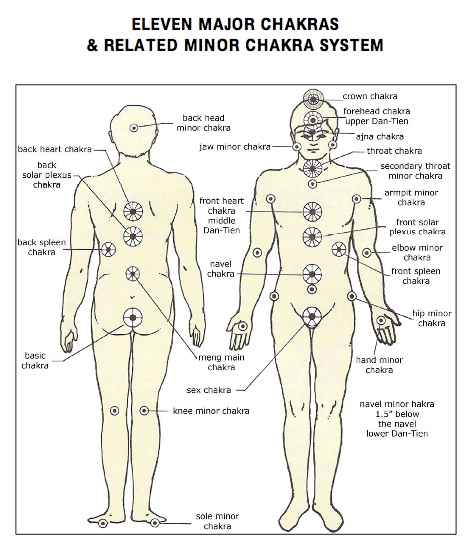
The chakras are the seven nerve centers in the body:
muladhara ---
base of the spine, the most basic of life's energysvadhisthana --
pelvic plexus, seat of passion and procreationmanipura --
navel plexus, corresponds to physical strength and poweranahata--
cardiac plexus, the heart chakra, seat of love, understanding, compassion and servicevisuddha --
vagus nerve, the throat chakra, center point of knowledge,
truth, communicationajina --
pineal gland, the point between your eyebrows, is the seat of the mind, perception and illuminance
sahasrara -- pituitary gland, the crown of the head, the point of unity
http://www.rivermaya.com/cakras.html
<
Bringing about Kundalini within the Church.
In many eastern religions, yoga is used to practice techniques aimed at actively
awakening kundalini.
http://www.hmt.com/kundalini/kundalini-faq.html#1a
"If you believe that kundalini is at the basis of spiritual progress then every valid spiritual tradition must have some awareness of kundalini. Christianity (especially Quakerism and Pentecostalism), Sufism, Cabalistic mysticism, alchemy and magick all have literature which demonstrates some awareness of the kundalini process but these traditions are not, to this author's awareness, so open in their exposition of the techniques and so it is hard to judge the depth of understanding latent in these traditions. Nevertheless, the imagery is so unmistakable in these traditions that each must have, at least at one time, been conversant with the movement of kundalini."
Kundalini can be awakened by devotion, selfless service, or by intellectual inquiry.
Siddha Mahayoga and the Kundalini Yogas use differing methods of awakening Kundalini. In Siddha Mahayoga the guru awakens the kundalini and in Kundalini Yogas the will is used to awaken the kundalini and guide it"s progress.
In relation to these two methods, let us consider how we can arrive at kundalini or "enlightenment" using charismatic methods.
The role of the minister or leader
in Siddha Mahayoga type kundalini.
This yoga is at least 1000 years old and is documented in the Kularnava Tantra and in the works of the great Tantric scholar Abhinvagupta. Also known as "the grace of the Guru, Shaktipat is a method by which an individual's kundalini is awakened by the direct intervention of a guru. If we put this in the context of a Church structure, the minister will use methods which will awaken kundalini within the members of the congregation. Where eastern mystics would see this as a result of positive and negative karmas , Christians would see this as the influence of spiritual forces either held by the leader or by the "Holy Spirit" (but more likely the demonic). Some people are more likely to experience kundalini at a deeper level than others.
The ability of using Shaktipat is given by a guru and passed on to the initiate. Care should be taken in who is given shakti as some people who have received shaktipat from well-known gurus have apparently only manifested greater neuroses and unhappiness in their lives as a result. Within the context of the Church, Shaktipat can be passed on through methods such as laying on of hands from those already having the "spirit" or ability of using Shaktipat.
There is no doubt that shakti is contagious. The mere presence of a single being whose shakti is strongly active can awaken the shakti of those around him. Similarly being in the presence of many people whose shakti is awakened to some degree can awaken one's own shakti. All that is required is that the student completely surrender to this force. For most people to reach such a point takes some practice. Within eastern mysticism chanting and selfless service are used. Within charismaticism, selflessness and use of tongues can help to produce the same effect.
By using the Siddha Mahayoga methods, Kundalini can be induced within the Church using repetitious tongues which have no meaning or purpose other than to deter thought, repetitious music with a steady beat (preferably as near to the human heartbeat as possible). Laying on of hands can be used to awaken shakti-kundalini from the minister or those with a strongly active shakti. This can mean that those from one area can pass on shakti-kundalini from leaders from one area, and pass these abilities / powers on to other leaders who then are able to use shakti-kundalini within their own Churches.
The aspects of surrendering to such forces and seeking them, enables the influence to be passed on, or induced. One method is to encourage people to empty their mind or speak in tongues, repeating phrases over and over again. Despite true Siddha Mahayoga involving the student and teacher role, the same roles can exist within the Church context. The more the initiate practices deeply surrendering to the spontaneous manifestations of kundalini shakti the deeper the experiences can become. In practice many practitioners experience kundalini awakening. Some experience it quite violently.
The result of Siddha Mahayoga methods within the Church.
The result of this are Kriyas, literally "activities". These are spontaneous movements that occur after kundalini awakening. These include bodily activities such as trembling, shaking and spontaneous yoga postures; vocal activities such as yelling, or spontaneous chanting and mental activities such as visions. Such chanting involves the use of "tongues" which are created within the mind of the person or by spiritual influence. Members of the congregation will also see pictures which many are all to eager to put a meaning to. The whole context of this method of attaining kundalini is surrendering to the guru or Leader.
The role of the Congregation in Sahaja Yoga (Spontaneous Yoga).
Where Siddha Mahayoga involves surrender to the guru, the Sahaja Yoga method uses the effort of the individual. It is generally observed that kundalini is more easily and reliably awakened by the grace of the guru than by individual effort.
"It is amazing how many people have had instant awakenings of kundalini through initiation from siddha gurus."
http://www.hmt.com/kundalini/kundalini-yoga.html#4
It seems that it is the guidance of the guru which is the determining factor as to which style of Yoga is effective. There is much debate as to which kundalini awakening method will produce fewer problems such as mental imbalance. The strength of Siddha Mahayoga is the ease with which it awakens the kundalini. The weakness is that because the kundalini is so easily awakened by the guru, students of Siddha Mahayoga often have completely undisciplined personal meditation practices.
Using Mantra or repetitious "tongues" or music to produce kundalini.
If the kundalini is to be awakened by means of this yoga then it is essential that the guru gives consciousness or ``chaitanya'' to the mantra. This consciousness can be viewed as the cit-shakti-kundalini. Through repetition of the mantra the cit-shakti-kundalini of the mantra resonates with the cit-shakti-kundalini of the student and in this way the student's kundalini is awakened. In the context of the Church, repetitious tongues for long lengths of time or repetitious songs can awaken kundalini.
Uniting of the prana and apana, or uniting of the rajas and retas.
In yoga the concept of kundalini is often referred to as fiery hot energy, or the "fierce woman" . Basically when kundalini is stirred, the fiery energy is activated or awakened by the uniting of the ``winds'' or ``energies'' of prana and apana. Prana is the life-giving energy associated with inspiration. It is associated with feelings of expansion and its center is in the heart. Apana is the downward-voiding energy associated with defecation. It is interesting to note that some Churches attach the move of the Spirit with defecation and wear nappies or diapers to Church meetings. It is associated with feelings of contraction and its center is in the anus. The uniting of these two very different forces creates a ``spark'' which awakens the kundalini from its slumber at the base of the spine.
Another description would be the uniting of the energies of the two channels of ida and pingal. The ida channel is associated with a cool energy that descends from the crown of the head. The pingala channel is associated with a hot energy that ascends to the crown.
A similar description is that kundalini is awakened through the uniting of the two bindus of rajas and retas. The bindu retas is associated with the sperm of man. The bindu rajas is associated with the egg (or sometimes menstrual blood) of woman.
But both more fundamentally refers to a constituent present in both men and women.
The fundamental approaches to awakening kundalini are through the uniting of the prana and apana, or through the uniting of the rajas and retas.
Uniting prana and apana
Two techniques are used to do this. In the vase breath exercise this is done by using phases of inspiration and retention and adding muscular control to cup the winds in a vase or pot below the navel. In bandha traya this is accomplished by phases of expiration and retention and adding muscular control to force the winds together in the abdominal region. These aspects are difficult to do within the context of the Church but can involve a willing on of emotions within, done unconsciously by the "worshipper" to produce a similar effect.
Uniting rajas and retas
The techniques involved here range from the gentle to the forceful. Using the gentle technique one attempts to bring the winds into the central channel by imagination or concentration alone. One visualizes an image, such as a deity central channel and lets their mind become absorbed in that. In the Church context the person would imagine the Holy Spirit being within and moving within them. This technique in Yoga is often complemented by breathing techniques. This use of visualization and the use of tongue mantras can enable kundalini to be awakened.
Other techniques of awakening kundalini using effort.
There are other methods of awakening kundalini used in Yoga. One method is sexual union, which has been observed as sometimes being induced outside Church buildings in cars in the car park etc. due to the inducement of the effects of kundalini. If the affect of kundalini is sleep, in the context of the Church, this possibly would be being slain in the Spirit, Some yogins would attempt to forcefully waken the person by dropping them on the floor. The context of kundalini in Yoga is the energy within. For the Christian whether this is literally power potential within the person or through an outside influence remains unclear.
The dangers of awakening kundalini.
Awakening kundalini has its dangers. Yogins believe kundalini brings unconscious material into our consciousness. If an individual is barely coping with his unconscious even under normal circumstances then awakening kundalini may push the individual over into psychosis. This phenomenon has been documented many times.
Breathing practices and the breath or prana is strongly interdependent on the mind. If one begins to actively control the breath then the mind will be affected. Unfortunately, with incorrect practice rather than bringing the mind to a greater state of equanimity the breath control practices can also create even greater imbalances in the mind.
"Typical signs of this are extreme agitation and anxiety. In the panorama of human suffering there is probably no greater suffering than that of a mentally unbalanced individual and no sadder example of this than someone who has actually brought a state of mental imbalance onto himself through improper practice of kundalini yoga"
"When the Kundalini awakens, tremendous power is unleashed. The resulting expansion of consciousness affects every element of our being, from our biological functions to our personal relationships to our concept of reality to our influence in the world. We are irrevocably changed in ways we could not have imagined and in ways we may never fully comprehend. " http://www.hmt.com/kundalini/danger.html
"A Kundalini release can be triggered by meditation, yoga, prayer, bodywork, psychedelic drugs, a life crisis (such as extreme physical or emotional trauma, a near-death experience or the death of a loved one), childbirth, menopause, certain ascetic or sexual practices, and so forth. Kundalini can also awaken spontaneously from no apparent cause."
"I have heard story after story of disastrous results when individuals with awakened Kundalini tried to force the process in any way."
The context of kundalini in Yoga and life in general.
Greenwell (1990) has noted seven categories of symptoms which have been observed during Kundalini awakening.
1. Pranic movements or kriyas
Prana is the Hindu word for vital energy. Thus as intense energy moves through the body and clears out physiological blocks, a person may experience intense involuntary, jerking movements of the body, including shaking, vibrations, spasm and contraction. As deeply held armouring and blockages to the smooth flow of energy are released, the person may re-access memories and emotions associated with past trauma and injury.2. Yogic Phenomena
Some people find themselves performing yogic postures or hand mudra gestures which they have never learned or could not do in a normal state of consciousness. Similarly, they may produce Sanskrit words or sounds, or have an awareness of inner music or sound, mantras or tones. Unusual breathing patterns may appear with either very rapid or slow, shallow breathing. Some people may not breathe at all for extended periods.3. Physiological Symptoms
A Kundalini awakening often generates unusual physiological activity as intense movement of energy releases toxins in the body. Symptoms include apparent heart problems, pains in head and spine, gastrointestinal disturbances and nervous problems. Internal sensations have been reported as sensations of burning, oversensitivity to sensory input, hyperactivity or lethargy, great variations in sexual desire and even spontaneous orgasm. Symptoms can be erratic, coming and going without provocation, but are generally unresponsive to medical treatment.4. Psychological Upheaval
Spiritual awakening offers a direct challenge to the primacy of ego consciousness and the myth of separation. It brings with it a challenge to move beyond the unconscious responses ruled by drives and instincts and remove ego consciousness from the canter stage of the psyche. It comes as no surprise that such a challenge produces a period of confusion and unbalance. People find themselves beset by inexplicable emotional states as they move to clear out unresolved issues. The emotional roller coaster may swing from feelings of anxiety, guilt and depression, through to compassion, love and joy, with accompanying bouts of uncontrollable weeping.5. Extra Sensory Experiences
As perception expands outside of consensus reality, people experience atypical visual phenomena, including visions of lights, symbols, entities, or review of past life experiences. Auditory input may include hearing voices, music, inner sounds or mantras. Even the olfactory system may be stimulated with perception of scents of sandalwood, rose or incense. There may also be disruption of the proprioceptive system, with losing a sense of self as a body, or feeling bigger than the body, or out of the body, with the resulting confusion and disorientation.6. Psychic Phenomena
With the opening up of psychic abilities, a person may experience precognition, telepathy, psychokinesis, awareness of auras and healing abilities.7. Mystical States of Consciousness
A person may shift into altered states of consciousness where they directly perceive the unity underlying the world of separation and experience a deep peace and serenity with a profound knowing of wisdom.
In some cases, the state of emergency due to psychological upheaval is so acute that it resembles a psychotic episode. Many clinicians still regard phenomena associated with spiritual emergence as indicative of pathology because the signs are so easily confused with the indicators of psychosis, mania, depression, schizophrenia or borderline personality disorder. Many people undergoing spiritual emergency are misdiagnosed and treated with suppressive medication which further complicates their process.
The context of Kundalini within the Church.
In realistic terms, these aspects of Kundalini are all to readily observed within certain Churches to one degree or another. Where the Bible links this aspect to people is within the realm of the spiritual. Unfortunately for many there is little distinction between what is Biblical and what is unbiblical in the desire for many to have a kundalini experience at Church. By this I mean having experiences likened to those above, desiring and obtaining them as encouraged by the leadership.
As there are serious side-effects to such experiences as admitted by the gurus, one wonders what should and can be done about this if there is no discernment as to what is of God and what is not. Who knows what damage has been done to believers and non-believers alike by the desire to attain kundalini, which is mistakenly considered to be the work of the Holy Spirit. Who judges what is "of the spirit" and what is not? And more importantly how do they know they are right in their presumptions.
So what is the answer to this? Well, to attain the experience of kundalini within the context of the Church is not within the context of the Bible. Whether intentionally or unintentionally, methods of worship, repetition and leadership style are resulting in kundalini phenomena within the individuals and this is deemed the work of the Holy Spirit. This is dangerous and blasphemous. Without a proper, biblical context in which worship is given as an offering and not necessarily for the benefit of the giver, where the word of God is used and preached, and where the Glory goes to God and not the "gifts" can stability begin to reign. Where there is order rather than disorder. In moving from the biblical realm into the unbiblical there is a very fine line and this line is drawn by the Word of God as stated in the Bible.
Many believe that we all have latent spiritual power, however whether we should use this or not and in which way should be governed by the scriptures, not by experience. In the experience realm of the supernatural there is little difference between what goes on in a Charismatic Church and what goes on in Eastern Mysticism, the only difference is that such activities are credited to the Holy Spirit in the Church. How easy it is to walk in deception if we interpret the Word of God in such a way as to justify such activities.
At the right is Kathryn Khulman transferring power in her classic manner. The victim was always "slain" by demonic power.
Read about such a church in Missouri
VIDEO:
HERE IS THE EVIDENCE THAT THERE IS A REAL PARALLEL
BETWEEN KUNDALINI AND CHARISMATIC MOVEMENT MANIFESTATIONS:
ANDREW STROM EXPOSED THE HISTORY OF SATANIC MANIFESTATIONS
Caveat: Andrew Strom is the Hillsong pastor who has brought in rock music and soft Charismatic novelties. This, in spite of the fact that he sees the errors so clearly here.
The anointing is from Lucifer
End of videos
KUNDALINI EKSTASIS WORSHIP IS DEMON DRIVEN AND PAGAN
End video
JOSEPH R. CHAMBER, Pentecostal pastor, is trying to deal with the Serpent Spirit in Charismatic circles. He, like Andrew Strom, makes a noble effort, but in the process he comes up with a necessary fiction. The fiction is this third category, the "paranormal." The Bible only tells us there is the spirit world and the physical world. There are evil spirits, while there are angels and God in the good spirit category. But, the Bible nowhere talks about the paranormal. That is a human device usually used by people who believe in zombies and UFOs. Why does Chambers do this? Answer: He is a rebel. He refuses to correctly use the Word of God which says in First Corinthians 13 that tongues and other revelatory manifestations shall cease. Chambers wants to cling to some nice tidy orderly manifestations so he can keep the sheep jabbering in tongues and making occasional prophecies.
WATCH THE POOR MAN JUGGLE THE BIBLE AND FICTION
Chambers and Strom are classic examples of deluded men trying to clean up the filthy hog pen without soap.
HERE IS PURE DEMON POSSESSION AT TORONTO AIRPORT CHURCH
The girl speaks clearly the Islamic declaration of faith in Allah in the midst of here performance, AND over and over repeats yaAllah, which means two things. Open meaning is, "For the sake of Allah," and the colloquial meaning is, "for Allah's sake," which is the blasphemous use of the name of Allah in the same way Westerners use, "for God's sake." This is used by Muslims in frustration when something is bothering them.
FINAL THOUGHT FROM THE EDITOR:
Now that you know the heritage of Charismatic manifestations, if you return to these service scenes, YOU WILL BECOME DEMON POSSESSED. God was possibly protecting you from this stuff, but he will NOT protect you if you return to blaspheme the Holy Ghost again. AND, by returning you show that you are damned to hell and have NO instincts to do right.
Also, in case you missed the point in the Kundalini discussion above, Kundalini is ALL about sexual perversion and includes sodomy and virtually any manner of sexual perversion as well as open sex in public. THIS IS YOUR DESTINY IF YOU DO NOT COME OUT OF CHARISMANIA. The devils of India will drive you to perversion if you are not already there.
Did that cause you to mock? Well, look at the Kundalini Chakra graphic at the top of the page. The "root chakra," the foundation of all the rest of Kundalini, is the female vagina or the male penis and testicles. That is the foundation of the Charismatic movement. The sodomy of Paul Crouch is just one small example of this, and the whore-like dress of Charismatic dollies is another. Seduction is the name of the game in Charismania.
I trust by now you hate me with a white hot passion, or you are grateful to me for showing you the exit. I do not sit here and put together this stuff to amuse myself. I want fruit unto righteousness, or I want to put in evidence in the court of God's justice that will finally condemn you to eternal damnation for your temerity and gall to blaspheme my God- that is, if you do not repent.
Psalms 139:17 How precious also are thy thoughts unto me, O God! how great is the sum of them!
18 If I should count them, they are more in number than the sand: when I awake, I am still with thee.
19 Surely thou wilt slay the wicked, O God: depart from me therefore, ye bloody men.
20 For they speak against thee wickedly, and thine enemies take thy name in vain.
21 Do not I hate them, O LORD, that hate thee? and am not I grieved with those that rise up against thee?
22 I hate them with perfect hatred: I count them mine enemies.
23 Search me, O God, and know my heart: try me, and know my thoughts:
24 And see if there be any wicked way in me, and lead me in the way everlasting.To hell with all blasphemers.
BACK TO THIRD WAVE CHARISMANIA MENU
BACK TO OPENING PAGE OF THE JOURNAL
BACK TO SERMONS AND BIBLE STUDIES
GE