HE
SHALL GIVE
HIS ANGELS....
A
tale of God's protection during the
Mau
Mau days in Kenya
By Steve Van Nattan Introduction: For
this story I need to give a very brief introduction so you learn more about the
the Mau Mau "Emergency" of 1952 -1957. The British Government, which
ruled Kenya as a colony much on the order of New England in the early days of
US History, did not want to call Mau Mau a revolution or a war. It was one tribe
rising up against British rule. None of the other tribes in Kenya took the Mau
Mau oath or joined in the fighting against the British. In
fact, several tribes were only too pleased to serve in the British African military
and fight against the Kikuyu tribe, or the Mau Mau. In particular, there was no
love lost between the Kikuyu and the Luo tribe who lived at the north end of Lake
Victoria. The
Mau Mau oath was said, by Kikuyu tribal elders, to be a resurrected rite from
the ancient past. It was an extremely vile and powerful oath, and it was very
Satanic. The power the oath had over the mind of the oath taker was amazing. Jomo
Kenyatta was the figure head of the Mau Mau, though it can be argued that he did
not approve of the extreme aspects of the uprising. He later became the nation's
first President, and he forbid the restoration of any Mau Mau activity. The
Mau Mau followed the Maoist text book as to revolution. They tried to force all
Kikuyu people to take the oath. And, they killed thousands of their own tribe
who refused to take it. They also killed many Christian Kikuyu out of white hot
hate for the Gospel. But, the Mau Mau seldom killed White British settlers or
missionaries. The reason for this was to keep the world press from talking about
Mau Mau and causing some other nation to come help the British deal with the "Emergency." To
illustrate the pure hate and vengeance the Mau Mau took out on anyone who refused
to take the oath, especially Christians, the pastor of the African local church
on Kijabe mission station, along with his wife and baby, were ambushed in the
forest by Mau Mau on the way to church one Sunday morning. Two Mau Mau grabbed
their baby and held it by the head and feet, and another Mau Mau chopped the baby
in half while the parents watched. Did
this cause the Kikuyu Christians to act in fear and terror? Answer:
The pastor and his wife went on to church, and the pastor preached his sermon
for the morning. The Christians were electrified by this man's zeal in Christ.
The next Sunday the church was packed, standing room only, and out onto the hillside.
Soon the church had to start meeting outdoors and use amplifiers because of the
church's growth. Remember this please when we get to the second guards discussed
on this page. Rift
Valley Academy, where I went to school in Kenya, had about 100 missionary
kids in it, and the school was in the virtual heart of Kikuyu country. It is 100
years old this year, 2009, and the corner stone was laid by Teddy Roosevelt while
he was on a hunting safari in Kenya. The school was located on a 700 acre mission
station named Kijabe, a mission station of the African
Inland Mission. Many missionaries and hundreds of African students lived on
the station along with us kids. The
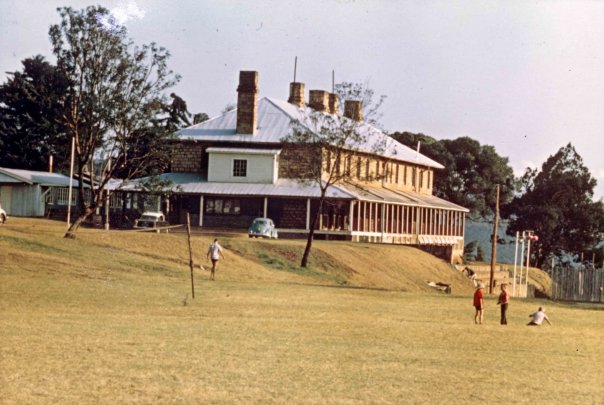
main building, built in 1909, is seen in the photo at the upper right. When
the big bell on a huge tower rang at any hour other than 7 AM and 5 PM, it meant
a Mau Mau presence had been detected. Missionaries would go inside and lock doors,
and we kids at the school were to go upstairs (hopefully below gun fire) and keep
our heads down. The missionaries on the station had nearly no defense against
an attack, should it come. We kids were another case. The mission and the government
considered us kids a prime target for attack. If we kids were killed it would
be a severe moral factor with all Whites in Kenya. To
keep us aware that there was a real bush war going on, we used to stand on the
verandah on the front of the main building and watch across the Rift Valley as
Lancaster bombers bombed
the caves around Mount Longonot
where the Mau Mau would hide. 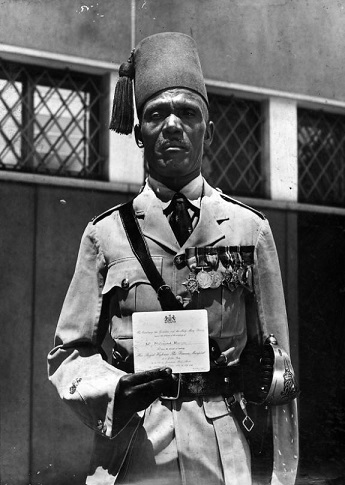
Guardian
One- The most obvious
The
King's African Rifles
So,
we were guarded 24 hours a day by a platoon of the Kings African Rifles. They
lived in a basement area beneath the main building of the school. They were almost
all from the Luo tribe and had two British officers in command of them. Almost
all had served in WW II in Belgium or Burma or both. In Burma they were the terror
of the Japanese who thought they would be cannibals and eat their prisoners. The
King's African Rifles solder at the left was clearly a sergeant of some rank.
The medals were probably earned in Burma and Belgium during WW II. The certificate
is very likely enrolling him into the "Queen's Royal Body Guard," a
very prestigious honor only for those who distinguished themselves in the perils
of the front lines. There were three famous national combat soldier units in the
British Empite, the Sudanese Regiments, the Guerkas of Napal and India, and the
King's African Rifles of Kenya. These were the soldiers that guarded my school
during the Mau Mau Uprising in Kenya. The
Sergeant Major of the platoon told me that when he and his soldier friends got
to Burma they heard of all the torture tricks of the Japanese, and they came up
with a plan. The first time they caught a couple of Japanese soldiers, they set
a big cooking pot on a fire filled with water. They then put one of the two Japanese
soldiers into the pot and started lighting a fire under it. They purposely neglected
the other Japanese soldier who decided to make a break to escape, which they let
him do. That soldier went back to his Japanese friends and told them they boiled
their enemy captures and ate them. I believe the British in charge rescued the
victim and shipped him far away to a prison camp. The Sergeant Major told me they
never again saw a Japanese soldier no matter how hard they looked for them. This
article is the first time and place where this story has ever been told as far
as I know. In
any case, the passion for the battle was in these men, so if our school had ever
been attacked, they would have been a very fierce enemy for the Mau Mau. In the
photo below you see the gate in the barbed wire fence around the school. There
were also bright night lights, and a swath of bamboo pointed punji sticks was
in front of the barbed wire fence. You can see a sand bag machine gun bunker in
the background behind some of my school mates. The fence and gate were much more
substantial by the time I was there. 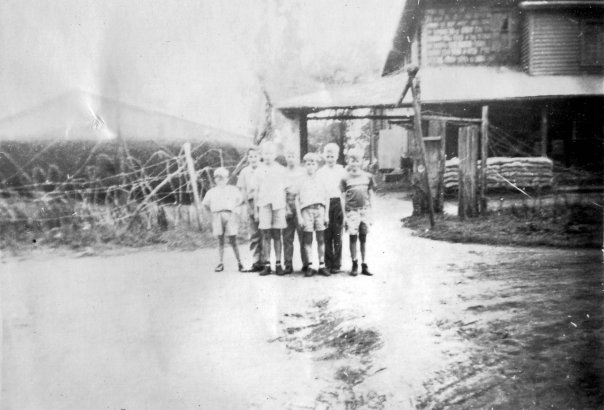 I
owe my life to the Lord who used those soldiers to intimidate the Mau Mau. They
were always full of fun and easy going. When the big bell rang, that meant there
had been Mau Mau spotted in the area. We kids would run inside the 12 foot barbed
wire fence and punji stick barrier and those Luo soldiers came out of their quarters
like raging loepards. The search lights came on, all the barbed wire gates dropped,
posts were dropped in holes in the road to stop motor attacks, and the Luo were
in their sand bag bunkers with their rifles and machine guns ready....., nay,
EAGER! I
owe my life to the Lord who used those soldiers to intimidate the Mau Mau. They
were always full of fun and easy going. When the big bell rang, that meant there
had been Mau Mau spotted in the area. We kids would run inside the 12 foot barbed
wire fence and punji stick barrier and those Luo soldiers came out of their quarters
like raging loepards. The search lights came on, all the barbed wire gates dropped,
posts were dropped in holes in the road to stop motor attacks, and the Luo were
in their sand bag bunkers with their rifles and machine guns ready....., nay,
EAGER!
But,
the man of distinction was not the British Lieutenant in command-- it was the
Luo Sergeant Major. He was a vet from Burma and Belgium, dead serious day and
night, and feared and respected by his men. He was decorated until the left side
of his tunic was completely covered with medals, and he was a member of the Queen's
Personal Body Guard (if she visited Kenya). 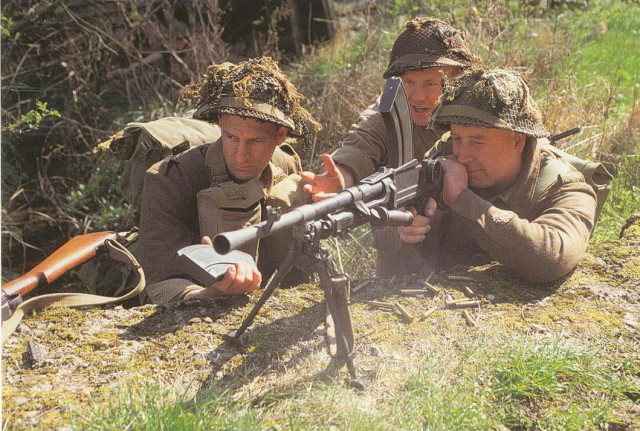 What
was his weapon? A Bren machine gun mounted in a custom shoulder stock. A Bren
gun is made to be fired laying down. It has two bi-pod legs attached to the front
of the machine gun which take 80% of the recoil. Here
is a video of a Bren gun being fired the normal way. Photo at right also.
Used by the British Army from 1930 to 1991. What
was his weapon? A Bren machine gun mounted in a custom shoulder stock. A Bren
gun is made to be fired laying down. It has two bi-pod legs attached to the front
of the machine gun which take 80% of the recoil. Here
is a video of a Bren gun being fired the normal way. Photo at right also.
Used by the British Army from 1930 to 1991.
The
1950s Bren gun took a 7.62 by 51mm cartridge, which was greatly downsized later.
Can you imagine the recoil that gun would have if you took off the bi-pod legs
and mounted it in a custom wood shoulder stock and stood up to fire it? When the
Sgt. Major fired it to prove he could handle it, we kids were in awe, as were
any missionary military veterans standing around. The trick was to take the horrible
impact of the kick AND keep the gun from climbing as he fired it. As
he fired the gun he would stand on a gravel parking area, rigid as steel, and
his whole body slid along backwards as he fired it. To show his strength, he would
hold a .303 British Army rifle by the end of the barrel in his huge fist and hold
it out straight and level with the ground for long enough to make your teeth crawl.
A Luo? Not someone to take lightly. We were all quite proud of our guards, and
they did give us a sense of safety. But,
there were other guards, not as conventional, whom the Lord used to defend us. 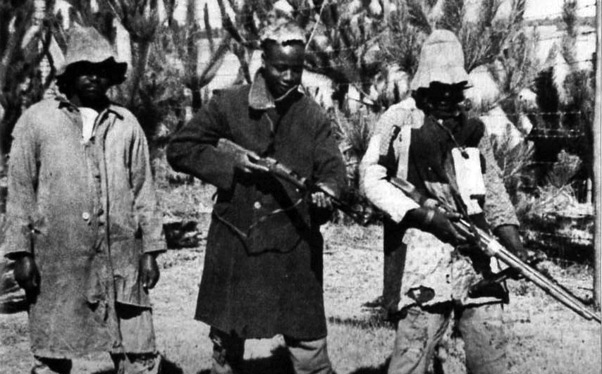
Ex-Mau
Mau gang members on the left serve as pseudos along with a white "Mau Mau"
pseudo in African disguise. The White pseudos had to almost always be sons of
British settlers, in which case they knew Kikuyu fluently by growing up in Kenya.
It was a totally secret operation that even the King's African Rifles did not
know about, and they risked being shot by British soldiers. This was possibly
one of the deepest secret operations ever. It would be like an American soldier
going underground in Afghanistan and joining Al Qaeda.
Guardian
Two-- The less obvious
Lest Thou Dash Thy Foot Against a Stone... I
had posted my memories of the following account, but a Rift Valley Academy student
who was older than I was, and who was on the scene before I arrived there, tells
the story much better than I can. So, here is her account:
______________________ The
Story, As I Lived It By
Joyce Baker Porte
I was thirteen when it all started..... with a bang, literally. One of the first
affects of the budding Emergency was the formation of an NRA chapter at our boarding
school, RVA, in Kijabe, Kenya. It was enthusiastically endorsed and run by Roy
Shafer, where we were taught to shoot rifles. At one point the British commander
of the KAR troops brought his machine gun and we were all instructed on its use,
including us girls. I saw through the pseudo-cheerful charade and realized that
we were being taught to use these guns on people, not targets. To this day I dislike
guns.
We had left Africa in 1946. Since it had been a long-delayed furlough and my parents,
support had dropped to 1/3 the required amount, it took us two years for them
to re-establish support and return to Africa in 1949. I was 12 by then, pretending
to be 16. Tension
already ran high among the Kikuyu people. About 1950, nasty things were happening
all around RVA's vicinity and our field trips and impromptu hikes were curtailed
for our safety. By 1951, when the British Government formally declared an Emergency,
we had barbed wire and pointed sticks surrounding Kiambogo, the school's main
building, and Kings African Rifles soldiers were living in the basement under
the porch. There
was no similar protection for the high school girls' dorm, the attic area over
the tichies's (lower grades) schoolroom, or the high school boys who lived at
Danny's Den with the Shafers at the end of the road up by the railroad tracks.
The situation
under discussion started when one of our senior girls crawled through the dirty
crawlspace to a spot just under the staff room to hear what the staff discussed.
This portion of the crawl space could only be accessed from the girls' side of
the building (at that time, boys and girls had distinct sides and were only allowed
to enter the others' side at certain events). She shortly crawled out with a distressed
look on her face, and we clustered around her to hear the news. While
the staff discussed usual events: who was misbehaving and their proper punishment,
who would go into Nairobi to get supplies and take kids to the dentist, etc.,
the door flew open and a station missionary filled in the gathered staff with
terrible news. Somehow, word had come that at least 300 Mau Mau were massing in
the forest above Kijabe waiting for dark when they planned to swoop down and kill
every one of us, as well as attack the African agricultural school and the African
girls' school and those who ran them. This was about 4:00 in the afternoon, and
only two or three hours until dark.
The school staff had previously planned for this possible event. Evacuation. A
large cave nearby had already been stocked with food and water and blankets. There
were two large lorries (trucks), enough to load all the students and carry them
to the cave. But there was a problem. One truck had been loaned out and wasn't
on the station. The other was broken down and waiting for parts. There
weren't enough
private vehicles to carry all 100 students, much less their teachers. The only
thing was to pray, and the staff fell on their knees in prayer. This was when
our informant crawled out. We were terrified. Should we tell anyone what we knew?
Should we tell the boys, since Danny's Den dorm was so vulnerable and they would
be first to go? We decided no to both questions.
After supper, we went to our dorm that was located just below the old hospital.
I couldn't study and neither could anyone else. We decided to wear our jeans to
bed, and we wrote letters to our parents and sewed them into our jeans in case
our dead bodies were someday found. Perhaps we were being melodramatic. But many
of us prayed and re-dedicated our lives to the Lord. Miss
Johnson, one of our house-parents, came up for devotions, her eyes bugged out
and barely able to contain her fear, though she never let on to us, nor we to
her, that something big was going to happen. We crawled into bed that night wondering
if it would be our last night. Not everyone in the dorm knew what we older ones
knew. Our group was seventh grade through twelfth.
The station settled down and everything was quiet. My bed was next to the only
window in the dorm, and I sat there and looked out. It must have been full moon
because the whole area was bathed in bright moonlight. I imagined terrorists hiding
in the deep shadows under the trees and bushes.
I don't know what time the alarm bell rang. The tall fire bell tower was put up
ostensibly to warn of fires, but also to warn of attack. Its toll could be heard
all over the 700-acre station. It was also the signal for each house or building
to blow the automobile horn they had in their attics. Each one had a code so others
would know which building it came from, the same code as the telephone party line.
The idea was to go around the station, starting with Danny's Den dorm and finishing
at Teasdale's at the bottom of the station by the printing press. Each beep would
be an all-clear signal, and we counted the beeps as we huddled under the window.
The omission of a horn meant trouble at that spot, and on the second round the
hospital did not give their signal. They had sighted the terrorists. As
I looked out the window, I saw our brave King's African Rifles troops, about 20
all together, march up the hill toward the hospital. After a short while, we heard
a number of rifle shots, then just quiet. Soon the troops marched back down the
hill to their quarters. Later, they said they did not fire the shots we heard-
there was no one there. The fire bell sounded an all clear. And that was it, until
some weeks later when we heard the real story. A Mau Mau was captured and interrogated,
and also asked about the purported attack. He told the following story.
Indeed, a large number of Mau Mau had gathered in the forest above the school
intending to attack the mission at night and kill us all. They had taken a vile,
satanic vow to do that.
But when they came down to attack the hospital first, they found men standing
all around the station perimeter. Thinking they were soldiers, they shot at these
men, but they didn't die even when it appeared they had been hit. They decided
that the mission had stronger magic than the Mau Mau had, so they turned and ran.
After this event, we were "blessed" with a full contingent of Lancashire
Fusiliers, British soldiers of distinction, who camped in tents on the lower
soccer field until some time after I graduated.
I am sure it is not coincidence that so many of my "age mates" returned
to Africa as missionaries, or became preachers or some other fulltime work for
the Lord. Knowing God's miraculous protection had a deep impression on me in particular,
and I believe that my prayers that night were a turning point in my life. But
I often puzzled why God would protect us so miraculously when so many Christian
Africans were slaughtered. White skin is no better than black skin in His eyes.
I asked
Him why, and He finally gave me the answer: He was not only protecting us, He
was protecting the African girls in their school, the African seminary students,
the agricultural school, the printing press that disseminated the Word of God
throughout Kenya, and the many missionaries who were overseers of those works.
In fact, more of His black children were protected that night than white ones.
This was a personal turning point for more than just me. The book by Dorothy W.
Smoker, Ambushed by Love, tells of many African Christians who were individually
protected miraculously during these stressful times. Joyce
Baker Porte: Also author of WHERE LIONS STILL ROAR and ROGUE
LIONESS, vols. 1 & 2 of THE TANGANYIKA TRILOGY, and STORMBIRD OF
THE SERENGETI, a short story collection. See my website at www.joycebakerporte.com
Thanks
Joyce for the graphic account of God's protection of his people. Now,
I want to make some observations. Here is a verse that indicates that the above
account is consistant with the Word of God and God's protection of his people
by using his angels. Psalms
91:11 (KJV) For he shall give his angels charge over thee, to keep thee in all
thy ways. Why
did the Lord let us learn about it? Perhaps
there were those among the missionaries and school kids who were in terror and
doubt as to God's attention to them, and they needed to learn that God WAS indeed
caring for them. Perhaps God wanted to show the British commander, Lt. "Chips",
that the reality of being totally committed to Christ manifested itself in very
literal ways in a Bible believer's life. Perhaps "Chip"s later made
a decision that will bring him to our side at the throne of God one day. One
more thought: Have you dedicated your home and real estate where YOU live the
Christ. Those angels were not standing at our doorways-- they were protecting
the people AND the mission station. It was GOD'S turf, and the battle was waged
at the property line. Please remember that the African church was growing like
wild fire as the Mau Mau persecuted them. God had decided the Mau Mau had gone
too far. Also, some of us at our school were not born again I am sure. They too
benefited from being with the people of God. They lived to have another chance
to confess Christ as their Savior. Food
for thought, right? Never
before or since have I been absolutely sure angels were involved personally in
watching over me. God seldom lets his angels show themselves. But, thank God,
they are real, personal, and we will be one with them in the Glory some day. What
stories we will hear then! Hebrews
11:32 (KJV) And what shall I more say? for the time would fail me to tell of Gedeon,
and of Barak, and of Samson, and of Jephthae; of David also, and Samuel, and of
the prophets:
33 Who through faith subdued kingdoms, wrought righteousness,
obtained promises, stopped the mouths of lions,
34 Quenched the violence of
fire, escaped the edge of the sword, out of weakness were made strong, waxed valiant
in fight, turned to flight the armies of the aliens.
35 Women received their
dead raised to life again: and others were tortured, not accepting deliverance;
that they might obtain a better resurrection:
36 And others had trial of cruel
mockings and scourgings, yea, moreover of bonds and imprisonment:
37 They
were stoned, they were sawn asunder, were tempted, were slain with the sword:
they wandered about in sheepskins and goatskins; being destitute, afflicted, tormented;
38 (Of whom the world was not worthy:) they wandered in deserts, and in mountains,
and in dens and caves of the earth.
39 And these all, having obtained a good
report through faith, received not the promise:
40 God having provided some
better thing for us, that they without us should not be made perfect. Little
children also receive special attention from "their angels." Matthew
18:10 Take heed that ye despise not one of these little ones; for I say unto you,
That in heaven their angels do always behold the face of my Father which is in
heaven. Every
little kid, who has not yet reached the age of accountability, has his own angel
watching over him. When a baby is aborted, we do not offend God only. We offend
the child's angel. Satan is only too eager to kill every baby he can, and it may
well be that those kids' angels are critical to see that those kids reach the
age when they can understand the Gospel and believe in Jesus Christ. This
thought is not literally from a text in the Bible, but I have to wonder..... Is
it possible that when you see a little baby look away and smile, which I have
seen myself many times, that baby is really seeing someone? And, at what age are
those angels relieved of that duty? No one knows. I fully expect that, when we
get to Heaven, we will hear some hair raising tales from our angel who watched
over us when we were little. So, for now, we walk by faith, and we thank our Savior
that he will never leave us or forsake us. Hebrews
13:5 Let your conversation be without covetousness; and be content with such things
as ye have: for he hath said, I will never leave thee, nor forsake thee. 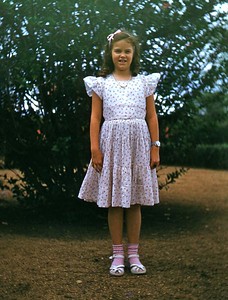 ELIZABETH,
MY WIFE, TELLS OF HER EXPERIENCES ELIZABETH,
MY WIFE, TELLS OF HER EXPERIENCES
My
wife Elizaabeth, when she was in school in Rift Valley Academy, was in my class.
That is how we first met. I was very impressed, but I was terrified to let her
know. The social mix at Rift Valley Academy was a bit warped by the culture of
missionary thinking. So, I did not let her know my thoughts until college. I have
thought it was best that way. The
photo at the right shows Elizabeth, then Hoover, as she looked at the time of
this account. Well,
Elizabeth was in on the Mau Mau Emergency just before I arrived in Kenya in fifth
grade. She tells below of her experiences. Her experience below happened shortly
after that of Joyce Porte above. Elisabeth
Van Nattan's account: During
the Mau Mau they had secured Rift Valley Academy with African and British military
guards and barbed wire. We were not allowed out of the Kiambogo building after
dark. The doors were all locked so no one could get in or go out, or so they thought.
One night
Miss Bellinger, one of the staff, was checking the little girls for the night
and she heard the door open at the top of the fire escape. She hurried to see
who was going out. I was on my way out walking in my sleep. She
pulled me back in and locked the door again, but she realized that I could try
it again later. She got me back in bed. I'm not sure she slept very well that
night knowing that I could do it again, but I didn't. Next day she had a slide
bolt put at the top of the door so this sleep walker couldn't reach it. I was
in the 3rd or 4th grade. I
also remember another night when the horns went off and we all had to get down
on the floor below the windows. Somebody had heard a gun shot and set off the
alarm thinking that there were Mau Mau on the mission station. There were some
of the girls who wanted to see if they could see what was going on outside and
they kept getting up to look out the window. They saw nothing and we found out
later that it was a false alarm. We
were not allowed out side after dark but we had one girl who did go out one night.
She had had an argument with a room mate, so she grabbed her slippers and threw
them out the window at the end of the building. Later she was repentant and decided
to go get the slippers. She
snuck out the fire escape door, which we used all the time, and ran around the
end of the building, grab the slippers and ran back up the stairs. A guard had
seen her and started yelling for her to stop but she was scared and kept on going.
She got inside and locked the door. The guard must have sensed that it was one
of the girls so he didn't fire at her, but she could have been in big trouble.
One day
Mr. Downing, our school principal, got word from the British officers guarding
us that the Mau Mau were going to attack our station and kill all the RVA kids
because they figured if they killed us they would get rid of the missionaries.
So the
one morning after breakfast we were told to get packed. We all had to leave Kijabe
that day. We would be assigned to go with somebody going towards where each one
lived. Tanzania kids went with people from the Kisumu area. Some kids were picked
up by parents and friends to be taken home so that there were none left in the
school. The only kids left were the ones whose families lived on the mission station,
Kijabe. I
went along with Anita Francis when we were put on the train west, and I think
there were a couple other girls with us. I think it was a Tuesday or Wednesday
so we had to stay with them near Kisumu until Saturday when the lake steamer left
for the south end of Lake Victoria near my parents' mission station. Anita
and her parents were really good us and we had a lot of fun during those days
with them. Those of us from Tanzania wondered how and where we would go because
the train always went through at night. But Mr. Downing had it all planned. The
missionaries in the western Kenya near the port city of Kisumu, on Lake Victoria,
would take those of us who went home to Tanzania. They would help us get onto
the lake steamer since tickets could not be bought in advance. Mr. and Mrs. Hess
from Tanzania were in Kenya at the time and offered to make arrangements for us
to go on the lake steamer even though they were booked up. Hesses were going home
from a holiday. No one in our mission could coax officials to bend rules and make
special arrangements like Uncle Charlie Hess. We
were all able to go. The captain of the ship, with Charlie Hess's encouragement,
simply made it work. The girls all slept in the lounge of the ship, and the boys
on deck. We all thought it was great fun! When you are a little kid you don't
see a grave situation like grown ups do. When
we got to Mwanza there was somebody from the mission there to meet the Hesses.
Were they ever surprised to see all the RVA kids on the ship. I don't remember
how we all got out to the mission headquarters at Makongoro. What I do remember
is that Dr. Bill Barnett was in Mwanza and was going home that day to Kola Ndoto
where my parents lived. He loaded my brother Don and I and his daughter, Ruth,
into the car and took us to Kola Ndoto. Our
parents were not expecting us home from school for another two weeks when our
normal vacation would start. Mother was teaching Bruce at home and trying to finish
up before lunch when I rushed in, threw my arms around her neck, and shocked her.
They had heard nothing about the kids being evacuated from Kijabe, so were very
surprised to see us and thankful for the care those in charge had taken to get
us out of the danger. To
me that was one of the most fun things that happened. The whole trip home was
fun for me and I didn't realize the gravity of it for a long time. This is another
way in which the Lord takes care of His children. He
leadeth his sheep forth.....
WHAT
TO TAKE AWAY FROM THIS FEARFUL STORY When
things are going badly, or even when things are the opposite and getting dull
and too mundane, it is so easy to wonder if God is really watching over us. Tales
like this story are also given to us so that we can all take courage and go on
with life believing that God sees the end of the journey and is very much in charge. Psalms
4:3 But know that the LORD hath set apart him that is godly for himself: the LORD
will hear when I call unto him.
4 Stand in awe, and sin not: commune with
your own heart upon your bed, and be still. Selah.
5 Offer the sacrifices
of righteousness, and put your trust in the LORD.
6 There be many that say,
Who will shew us any good? LORD, lift thou up the light of thy countenance upon
us.
7 Thou hast put gladness in my heart, more than in the time that their
corn and their wine increased.
8 I will both lay me down in peace, and sleep:
for thou, LORD, only makest me dwell in safety. So,
when life seems dull and slow, or when we have served God, and nothing seems to
be happening, we should at least praise him that the enemy has been restrained
and God is in charge after all.
 LINKS: A
RATHER MUDDLED UP ACCOUNT OF MAU MAU A
MORE ACCURATE ACCOUNT BY A KIKUYU KENYAN ACCOUNT
OF THE LARI MASSACRE
This article fails to tell that many
Christians lived in Lari, and that is one of the main reasons the Mau Mau chose
that village to massacre. Missionaries who went up from Kijabe mission station
early in the morning, hoping to help survivors, said the blood was literally flowing
down the path from the hill from the victims of the Mau Mau who tried to flee
as their homes burned. There were almost no survivors. Joyce
Baker Porte's comments on the Lari massacre: Roy
Shaffer knows it best, I believe. I remember, too.
We saw the fire in the sky that night from Kiambogo porch. It seems very close.
We heard that the Mau Mau came at night, wedged boards against the door of all
the houses, and burned them down with the people unable to escape. Most of the
people in the village were Christians.
A few days later (it could have been the next day) we saw bedrolls against the
walls of our classrooms, as they were opened up to Africans to spend the night
in the safety of the school. By day, they went to their work and fields, and at
night came back to the classrooms. We were ordered, practically under threat of
death, to not pry, or disturb, or touch their belongings. I believe no one did.
We saw, too,
the fires over by Logonot where settlers places were burned. We heard about how
the ranch cattle had their lower legs cut off and were left to die slowly, unable
to move (poor cows:how were they responsible for anything?). Some of the girls
who volunteered at the hospital saw the people with hands cut off (children, too),
and people with their eardrums pierced to keep them from hearing the white man's
lies. Elizabeth was a tichie then, and I don't know how much they were informed
of what was going on. What does she remember?
Some years later I read a book by the American ambassador to Kenya in Nairobi,
mostly a self-serving book (what a wonderful person I am, I did all these wonderful
things in Africa they would never do for themselves). In it, he said his response
to requests for aid to a possible attack at RVA was that missionaries were basically
despicable people, and if they chose to put their children in harm's way, then
so be it. So the Lord had to step in and save us all!
Still, it was the Africans who suffered the most.
Joyce
VIDEO
ON MAU MAU BY BRITISH FROM THAT ERA

BACK
TO YARN MENU BACK
TO ENTRY PAGE OF THE JOURNAL
| 